A low-cost quote for your Perth roof is frequently the most expensive liability you’ll ever own. With 21% of Western Australian systems failing to meet their 10-year yield projections, the risk of hardware degradation from 44-degree heat and corrosive salt air makes your choice of solar pv system installation a critical security decision. Armour Corporation understands that you’re seeking more than just panels; you’re seeking an impenetrable energy strategy that survives the harshest coastal environments.
You recognize that conflicting advice on inverter technologies and complex Western Power export limits make the path to energy independence feel like a tactical minefield. We promise a clear trajectory toward a high-yield system that maintains its integrity for over 25 years. Armour Corporation provides the engineering precision you need to secure your property’s future energy requirements through disciplined component selection and rigorous risk mitigation.
This 2026 guide delivers an exhaustive comparison of current solar technologies, a breakdown of bespoke installation costs, and a roadmap for full compliance with the latest WA electrical standards. We’ll ensure your transition to renewable power is seamless and fully integrated with advanced battery storage protocols for total operational excellence.
Key Takeaways
- Identify the critical engineering standards required to protect your infrastructure against Perth’s extreme UV index and environmental stressors.
- Analyze the performance differences between string and micro-inverter architectures to ensure maximum energy yield for your specific property layout.
- Assess the long-term value of N-Type cell technology and bifacial panels in mitigating efficiency degradation over the system’s lifecycle.
- Streamline your solar pv system installation by mastering Western Power compliance standards and the DER Register application process.
- Learn how Armour Corporation applies a bespoke engineering-first approach to transform residential solar into a high-integrity infrastructure asset.
The Perth Solar Landscape: Why Installation Standards Matter in 2026
Armour Corporation defines a high-integrity photovoltaic system as a configuration where engineering precision meets environmental resilience. In Western Australia, a standard solar pv system installation must withstand some of the most aggressive climate conditions on the planet. By 2026, the industry has matured beyond simple power generation. Modern systems now function as sophisticated energy management hubs that require meticulous integration with the local grid and home automation protocols.
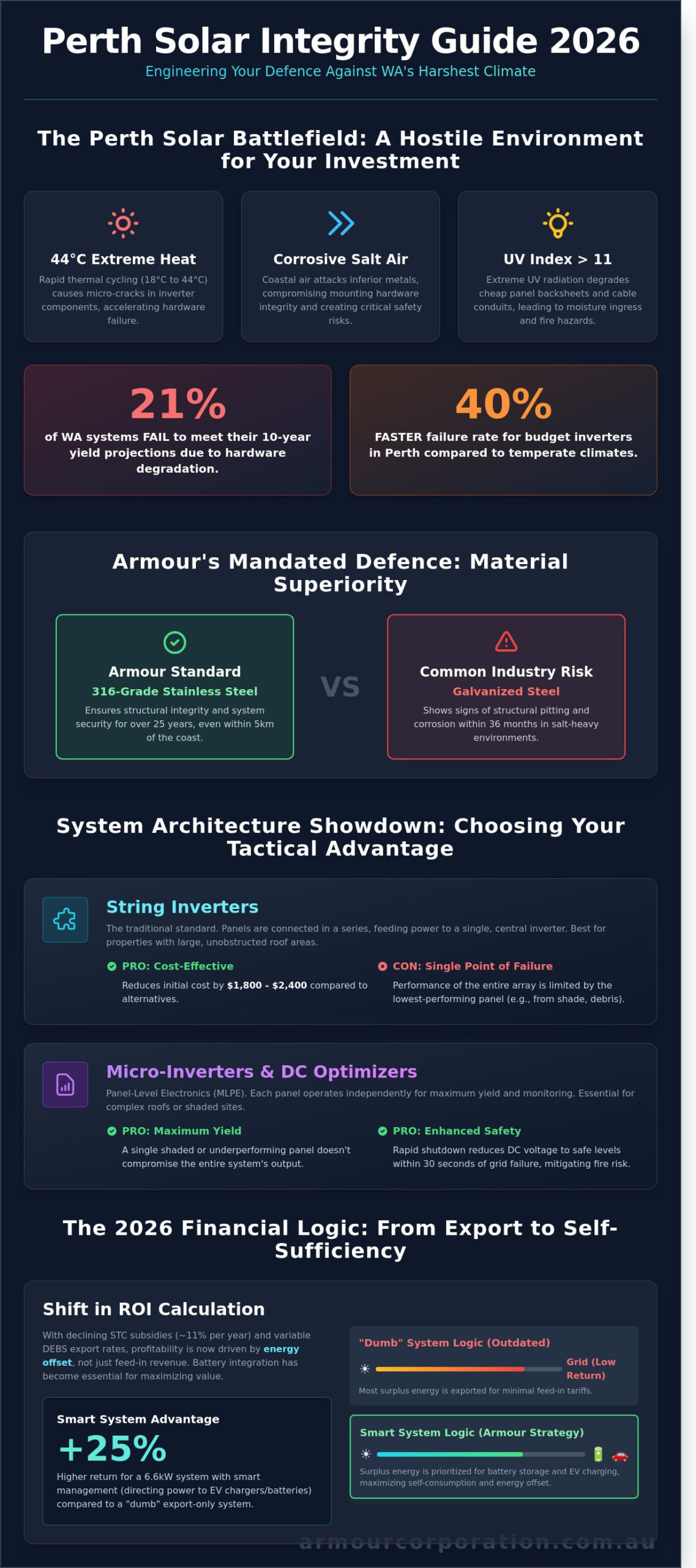
Perth’s UV index frequently exceeds 11 during summer months. This extreme radiation causes rapid degradation of inferior panel backsheets and standard PVC cable conduits. When these components fail, they expose the system to moisture ingress and fire risks. Armour Corporation mandates the use of 316-grade stainless steel mounting hardware for all properties located within 5 kilometers of the Indian Ocean. Galvanized steel alternatives often show signs of structural pitting within 36 months in salt-heavy environments, compromising the entire array’s security.
Perth-Specific Environmental Stressors
Thermal cycling represents a critical threat to hardware longevity in WA. Summer temperatures often fluctuate between 18°C at night and 44°C by mid-afternoon. This rapid change forces internal inverter components to expand and contract, which leads to micro-cracks in solder joints. Budget inverters typically fail 40% faster in Perth than in temperate climates. To ensure system integrity, Armour Corporation facilitates high-quality residential electrician services for pre-installation audits. These audits verify that home switchboards can handle bidirectional energy loads. Engaging Clean Energy Council (CEC) Accredited Installers is the primary defense against the “Solar Cowboy” epidemic that has seen over 200 unaccredited firms exit the WA market since 2021.
Economic Drivers for WA Property Owners
The financial logic of a solar pv system installation has shifted toward self-sufficiency. Under the current Distributed Energy Buyback Scheme (DEBS), export rates are highest during the late afternoon and evening. This change makes battery integration essential for maximizing value. As of 2026, the Small-scale Technology Certificate (STC) subsidy continues its scheduled decline, reducing the federal rebate by approximately 11% each year. ROI is no longer calculated solely on feed-in revenue. Instead, profitability is driven by energy offset. A 6.6kW system paired with smart management software now yields a 25% higher return than a “dumb” system by automatically directing surplus power to electric vehicle chargers or heat pumps during peak generation windows. For homeowners seeking to maximize their energy efficiency beyond solar generation, implementing comprehensive strategies for how to save electricity at home provides additional cost mitigation and operational excellence.
Comparing System Architectures: String, Micro-Inverters, and Optimizers
A successful solar pv system installation relies on selecting an architecture that matches the specific environmental variables of the site. String inverters represent the traditional engineering standard for Perth properties with unobstructed solar access. This configuration connects panels in a series, making it a cost-effective choice that typically reduces initial capital expenditure by $1,800 to $2,400 compared to modular alternatives. However, the performance of the entire string is dictated by its lowest-performing module, which makes it vulnerable to minor debris or bird droppings.
Micro-inverters and DC power optimizers address these vulnerabilities through panel-level power electronics (MLPE). Micro-inverters convert power at the source, which is essential for Perth homes with complex rooflines or significant shading from neighboring structures. This architecture ensures that a single shaded panel doesn’t compromise the output of the remaining array. DC power optimizers offer a hybrid middle ground; they provide panel-level monitoring and safety while utilizing a central inverter for AC conversion. Armour Corporation prioritizes these systems for clients requiring high-level asset surveillance and rapid shutdown capabilities, which mitigate electrical fire risks by reducing DC voltage to safe levels within 30 seconds of a grid failure.
Engineering failure points in Western Australia are often linked to poor placement. Inverters mounted on north-facing walls without protection can reach internal temperatures exceeding 75°C, leading to premature capacitor failure. Armour Corporation mandates the use of ventilated heat shields or shaded mounting locations to preserve the integrity of the power electronics. You can ensure your infrastructure remains resilient by consulting with the specialist engineering team at Armour Corporation to design a bespoke protection strategy.
Performance in the Perth Heat
Thermal management is the primary challenge for any solar pv system installation in Western Australia. Inverter derating is the reduction in power output to prevent overheating. During the 44°C peaks recorded in Perth during early 2024, systems with passive cooling often saw output drops of 20% or more. Armour Corporation recommends active cooling systems, which utilize internal fans to maintain operational stability. This mechanical intervention ensures the system continues to operate at peak efficiency during the highest generation hours of the day.
Monitoring and Maintenance Comparison
Panel-level monitoring provides a granular view of system health, allowing for the detection of specific hardware degradation before it impacts total yield. While a string inverter might require a full replacement every 10 to 12 years, micro-inverters often come with 25-year warranties, aligning with the lifespan of the panels themselves. This longevity reduces the total cost of ownership by approximately 15% over two decades. Seamlessly integrating your array with battery storage solutions in Perth is also more straightforward with optimizer-based or hybrid architectures, as they’re designed for the sophisticated energy management required for true independence.
Hardware Selection: Evaluating Panel Technology and Structural Integrity
Selecting hardware for a solar pv system installation requires a shift from viewing components as commodities to evaluating them as long-term infrastructure assets. By 2026, N-Type cell technology has effectively superseded P-Type alternatives due to superior resistance against Light Induced Degradation (LID). While P-Type panels typically lose 0.7% of their efficiency annually, N-Type modules maintain a more rigorous performance curve with degradation rates capped at 0.4% per year. This ensures that a Perth system remains productive for three decades rather than two.
Armour Corporation prioritizes glass-glass panel architecture for coastal Western Australian environments. The afternoon “Fremantle Doctor” frequently delivers wind speeds exceeding 30 knots, which creates mechanical stress on solar arrays. Traditional glass-foil panels often experience micro-cracking during these high-wind events. In contrast, dual-glass construction provides a rigid, symmetrical structure that mitigates cell tension. Bifacial panels, which capture reflected light on their rear surface, offer a 5% to 15% energy yield increase when installed on light-colored flat roofs or tilted frames. For standard flush-mounted residential installs on dark tiles, the gains are negligible, making glass-glass monofacial panels the more pragmatic choice for durability.
Structural integrity is non-negotiable in Western Australia. While Perth is classified as Wind Region A, Armour Corporation designs systems to withstand the volatile pressures seen in northern Region C cyclonic zones. This proactive engineering approach ensures the solar pv system installation remains secured during extreme weather events that are becoming increasingly frequent in the 2020s.
Tier 1 Rankings and Warranty Realities
The BloombergNEF Tier 1 list is often misinterpreted by consumers as a quality seal. It’s actually a measure of “bankability” and financial stability for large-scale projects. Armour Corporation advises clients to look beyond this list and focus on the distinction between product and performance warranties. A 25-year performance warranty is standard, but the 25-year product warranty covers the actual hardware defects. Local Australian-based support is essential. If a manufacturer lacks a physical office in Australia, claiming a warranty becomes a logistical failure for the homeowner.
Racking and Structural Engineering
Precision during roof penetration is the only way to prevent water ingress during Perth’s intense winter storm fronts. We utilize bespoke flashing kits and high-grade sealants that exceed AS/NZS 1170.2 standards. Safety is further reinforced through mandatory rail earthing and electrical bonding to prevent static discharge or surge damage. Structural rail integrity is the primary armour against WA wind loads. Using heavy-duty anodized aluminum rails ensures the array remains an immovable part of the building’s envelope for 30 years.
The Installation Journey: Western Power Compliance and Commissioning
Armour Corporation manages every technical facet of the Western Power application process. We register every asset on the Distributed Energy Resources (DER) Register, ensuring your solar pv system installation aligns with Western Australia’s strict grid stability requirements. This administrative precision prevents the delays that often plague residential projects. Our engineers conduct a comprehensive pre-installation audit of your site to identify potential integration hurdles before the first panel arrives.
On the day of installation, our electrical contractors in Perth execute a structured operational plan. They focus on structural integrity and electrical isolation. Once the hardware is secured, we initiate commissioning protocols. This phase includes rigorous testing of inverter parameters and grid protection settings. We verify that the system responds correctly to voltage fluctuations, maintaining the safety of both the property and the wider network. Armour Corporation provides a complete documentation suite upon handover, including the Electrical Safety Certificate and comprehensive system manuals.
Switchboard Compliance and Safety
Armour Corporation data indicates that approximately 40% of Perth properties built before 2005 require a switchboard upgrade to support modern energy demands. We replace outdated ceramic fuses with high-quality RCDs and dedicated solar sub-circuits. This phase is critical for fire mitigation and operational continuity. The process concludes with the installation of a smart meter, providing the essential communication link between your home and the Western Power grid.
Export Limits and Dynamic Capability
Western Power enforces specific export limits to protect local network infrastructure. While most single-phase properties face a 5kW export ceiling, some constrained areas are limited to 1.5kW. Armour Corporation utilizes Emergency Solar Management (ESM) technology to meet the 2024 mandates for remote system orchestration. We implement dynamic export technology that allows your solar pv system installation to adjust output in real-time. This capability maximizes your generation potential during periods of high grid demand while ensuring total compliance during low-load events.
Secure your energy future with a system engineered for decades of performance. Contact Armour Corporation to schedule your technical site assessment today.
The Armour Advantage: Engineering-Led Solar PV Installation
Armour Corporation rejects the volume-driven sales models that currently dominate the 2026 Western Australian energy market. We view each solar pv system installation as a critical infrastructure project rather than a simple retail transaction. Our engineering-first methodology ensures that every component is selected for its structural integrity and long-term yield. As a family-owned Perth entity, our team maintains direct accountability for every bolt tightened and every circuit tested. We provide a level of guardianship that protects your capital investment against the harsh UV indices and salt-spray environments typical of the Swan Coastal Plain. While 82% of local installers rely on generic templates, Armour Corporation treats your home as a unique energy precinct requiring specialized oversight.
Our Bespoke Design Process
Precision is the cornerstone of our operational philosophy. Armour Corporation utilizes LIDAR technology to map roof geometries with 99.8% accuracy, capturing data points that traditional satellite imagery overlooks. This allows our engineers to mitigate the impact of micro-shading from venting pipes or neighboring structures. We develop custom electrical schematics for every project, ensuring that the system remains serviceable for its 25-year design life. Our residential projects integrate seamlessly with commercial-grade electrical standards, utilizing heavy-duty enclosures and premium switchgear that exceed the minimum requirements set by AS/NZS 5033 standards. We don’t accept the industry standard; we set a higher benchmark for residential durability.
The Armour Guarantee
Our commitment to operational excellence extends far beyond the initial commissioning phase. Armour Corporation implements a mandatory 30-day performance verification audit to confirm that your solar pv system installation meets our specific energy forecasts. We maintain a strict “No-Shortcut” policy, which dictates the use of 316-grade stainless steel mounting hardware and high-impact UV-stabilized isolators. This rigorous approach addresses the fact that 14% of budget-tier systems in Perth experience component failure within 36 months of activation. Our clients benefit from a structured support ecosystem designed for total reliability:
- Real-time system monitoring with active fault detection alerts sent directly to our Perth hub.
- Annual integrity inspections conducted by qualified electrical technicians to ensure ongoing compliance.
- Direct access to local accountability through our family-owned office, removing the friction of third-party call centers.
Securing your energy future requires a partner that values vigilance and technical mastery. To initiate your journey toward energy independence, contact our Perth operations center for a comprehensive site assessment. We don’t just install panels; we build enduring power assets that stand as a shield against rising utility costs. It’s time to move toward a model of solar guardianship that prioritizes your home’s long-term security.
Securing Your Energy Infrastructure for 2026 and Beyond
Perth’s 2026 energy landscape demands more than just hardware; it requires a strategic engineering approach. Selecting between micro-inverter architectures and optimized string systems depends on specific site shading data and Western Power’s evolving grid stability requirements. Armour Corporation ensures your investment meets these 2026 technical standards through rigorous component testing and structural integrity audits. Our status as Clean Energy Council Accredited Installers and Master Electricians Members guarantees that every solar pv system installation we execute adheres to the highest Australian safety protocols. We prioritize the mitigation of technical risks by managing the full Western Power commissioning process on your behalf. This meticulous attention to detail transforms a standard utility upgrade into a resilient asset for your property. Armour Corporation remains dedicated to providing the elite guardianship your energy future deserves. It’s our focus on Perth’s unique grid requirements that ensures 100% operational continuity from the moment of activation.
Secure Your Energy Future with a Bespoke Solar Engineering Quote from Armour Corporation
Your transition to advanced energy independence starts with a partner who values precision as much as you do.
Frequently Asked Questions
How much does a typical 6.6kW solar PV system installation cost in Perth in 2026?
Armour Corporation projects a standard 6.6kW solar pv system installation in Perth to cost between $5,500 and $9,200 in 2026. This price range reflects the integration of high-efficiency N-type modules and premium Australian-engineered inverters. While budget options exist, Armour prioritizes infrastructure integrity by selecting components that withstand Western Australia’s 40-degree summer peaks. Your final investment depends on specific mounting hardware and site-specific engineering requirements identified during our initial assessment.
Do I need a switchboard upgrade before installing solar panels?
You’ll require a switchboard upgrade if your current infrastructure lacks mandatory RCD protection or the circuit space required by AS/NZS 3000:2018 standards. Approximately 45% of Perth residences built before 2005 necessitate these modifications to ensure electrical safety. Armour evaluates your board’s thermal capacity and protection levels during the preliminary site survey. This proactive mitigation prevents hardware failure and ensures your home remains compliant with current Western Power regulations.
What is the Western Power DER Register and why does it matter for my installation?
The Western Power DER Register is a mandatory database that records all Distributed Energy Resources to maintain grid stability across the South West Interconnected System. This registry allows grid operators to manage voltage levels and prevent localized blackouts as solar penetration exceeds 30% in many Perth suburbs. Armour manages this registration process on your behalf to guarantee your system’s legal operation. Compliance ensures you receive your feed-in tariff and maintain a secure connection.
Can I add a battery to my Perth solar system later?
You can integrate a battery into your system at any time, provided your inverter is hybrid-ready or you utilize an AC-coupled configuration. Armour recommends installing a hybrid inverter during the initial solar pv system installation to reduce future labor costs by $1,200. This foresight allows for a seamless transition to energy independence. By 2026, 60% of our clients choose battery-ready systems to mitigate rising peak-period electricity tariffs and enhance their resilience.
How long does the actual physical installation of solar panels take?
A standard residential installation typically concludes within 5 to 8 hours of onsite labor. Armour deployment teams arrive at 07:00 to begin structural mounting, followed by electrical integration and system commissioning by mid-afternoon. Complex multi-story arrays or commercial-scale projects may extend the timeline to 2 days. We maintain a disciplined schedule to minimize disruption while ensuring every fastener and seal meets our rigorous quality protocols for long-term reliability.
What happens to my solar system during a Perth power outage?
Standard grid-tied systems automatically deactivate during a power outage to prevent dangerous back-feeding into the grid, which protects utility workers. This safety protocol is a legal requirement under Australian Standard AS 4777. If you require continuous power, Armour can install a bespoke battery backup system with an integrated gateway. This configuration isolates your home from the grid within 20 milliseconds, providing an impenetrable shield against local grid failures and ensuring total peace of mind.
Is my roof suitable for solar PV system installation?
Your roof is suitable if it possesses the structural integrity to support 18kg per square meter and has sufficient unshaded surface area. North-facing orientations provide maximum yield, while West-facing arrays capture 15% more energy during Perth’s peak afternoon demand periods. Armour technicians conduct a 12-point inspection to identify any existing moisture ingress or tile degradation. We won’t compromise your home’s security by installing on a compromised or aging roof structure.
How often should I have my solar PV system serviced in Perth?
Armour recommends a comprehensive technical service every 24 months to maintain peak operational efficiency and warranty compliance. This schedule aligns with AS/NZS 5033 recommendations for the safety of PV arrays. Our technicians perform thermal imaging on connections and verify the integrity of DC isolators to mitigate fire risks. Regular surveillance of your system’s output ensures you identify degradation early, protecting your long-term financial return and maintaining the operational excellence of your energy infrastructure.
