
The traditional reliance on the Western Australian power grid has become a strategic vulnerability for the modern homeowner. As peak electricity prices in Perth continue to climb, the integration of a high-performance solar battery is no longer a luxury; it’s a necessary measure for financial mitigation. Armour Corporation recognizes that the 2024 shift in Distributed Energy Buyback Scheme (DEBS) rates has left many residents feeling exposed to diminishing returns on their renewable investments. You’ve likely noticed that your surplus energy is sold back for a fraction of its worth while your evening bills remain high.
We promise to provide the technical precision and financial clarity required to secure your home’s energy integrity. Protecting your household requires a bespoke engineering approach that survives the relentless 44-degree Perth summer heat without system degradation. This 2026 guide serves as your strategic manual for total energy independence. We’ll examine high-tier storage specifications, clarify the complex buyback landscape, and provide a disciplined roadmap to ensure your property remains an impenetrable shield against future utility price hikes.
Key Takeaways
- Armour Corporation evaluates the 2026 Federal Cheaper Home Batteries Program to ensure your path to energy independence is both strategically and financially sound.
- Understand the technical superiority of Lithium Iron Phosphate (LFP) chemistry in providing a safe and resilient energy architecture for Western Australian homes.
- Determine the optimal storage capacity to mitigate rising utility costs and sustain operational efficiency during Perth’s demanding peak evening periods.
- Master the complexities of Western Power compliance and export limiting to ensure a seamless and secure solar battery integration.
- Recognize why professional engineering expertise and meticulous installation standards are the ultimate safeguards for your long-term energy security.
The 2026 Solar Battery Landscape in Western Australia
Armour Corporation views energy storage as a fundamental pillar of residential and commercial security. A solar battery serves as a high-performance storage unit that captures surplus energy generated by photovoltaic panels during peak sunlight. This stored power is then deployed during the evening when electricity prices in Perth reach their highest levels. By 2026, the necessity of these systems has become clear. They provide a vital layer of protection against rising utility costs and grid instability. Armour Corporation maintains that energy independence is the ultimate safeguard for the modern property owner.
The Federal Rebate and WA Incentives
The Federal Cheaper Home Batteries Program has transformed the accessibility of energy storage for Perth residents. Current 2026 incentives allow homeowners to claim a discount exceeding A$1,000 on eligible small-scale systems. Eligibility requires that the property is located within the South West Interconnected System (SWIS) and utilizes hardware that adheres to rigorous Australian safety standards. Armour Corporation assists clients in navigating these technical requirements to ensure full compliance and maximum financial recovery. These federal measures work in tandem with local Western Australian initiatives to reduce the initial capital expenditure for both residential and commercial sectors. Most modern systems utilize advanced rechargeable battery technologies to maintain high efficiency over a ten-year operational lifespan. Our team ensures that every installation meets the strict criteria required to trigger these financial incentives.
Why Perth Homes are Transitioning to Storage
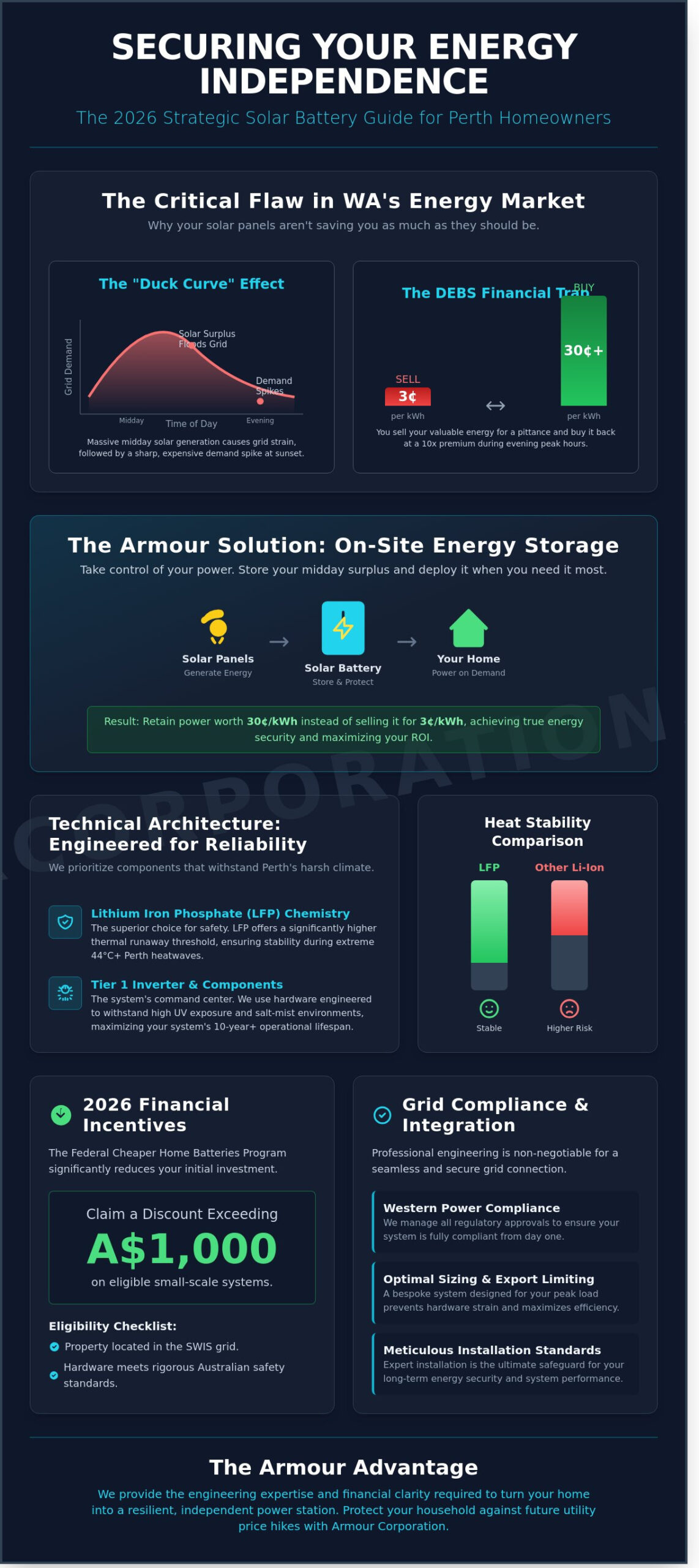
Western Australia’s energy market is currently defined by the “Duck Curve” phenomenon. This occurs when massive amounts of solar energy are fed into the grid at midday, followed by a sharp spike in demand at sunset. This imbalance threatens grid integrity and has led to the implementation of the Distributed Energy Buyback Scheme (DEBS). The financial implications are significant for any household without storage:
- Energy exported to the grid often returns as little as 3c per kWh under current DEBS rates.
- Peak evening electricity costs from the grid frequently exceed 30c per kWh.
- A solar battery allows households to bridge this gap, retaining power worth 30c rather than selling it for 3c.
- Bespoke backup capabilities protect sensitive electronics during unpredictable grid fluctuations.
Armour Corporation prioritizes the mitigation of external risks. Storing energy on-site provides a reliable buffer that safeguards against localized grid outages. This transition is no longer just about savings; it is about establishing a secure, independent energy perimeter for the modern Perth home. We provide the engineering expertise required to turn a standard solar array into a resilient power station.
Technical Architecture: Engineering for Reliability and Safety
The inverter serves as the operational command center. It regulates energy flow and protects the battery cells from premature degradation. Armour Corporation utilizes Tier 1 hardware exclusively. These components are engineered to withstand the high UV exposure and salt-mist environments typical of the Swan Coastal Plain. Every bespoke system we design matches the battery discharge rate to your specific peak household load. This prevents hardware strain and maximizes the 10-year operational lifespan expected of modern units.
AC vs DC Coupling: Which is Right for Your Perth Home?
AC coupling remains the tactical choice for retrofitting batteries to existing solar arrays. It allows for independent operation and simplified integration without disrupting the original inverter setup. While AC systems incur slight conversion losses, they provide the flexibility required for older Perth homes. Selecting the correct architecture ensures your solar battery operates at peak performance throughout its lifecycle.
Safety Standards and AS/NZS 5139 Compliance
Substandard installations often bypass these critical safety measures to reduce upfront costs. This compromises the security of your property and may void insurance policies. Our team conducts thorough site assessments to ensure every unit meets current 2026 regulatory demands. For a comprehensive evaluation of your property’s energy security, consult with our engineering specialists to discuss a tailored protection plan.
Sizing Your Storage: ROI Analysis for the Perth Climate
Armour Corporation approaches energy storage as a precise engineering discipline rather than a retail transaction. A solar battery serves as a strategic asset, and its value is entirely dependent on accurate sizing. Selecting a capacity that is too small leads to grid reliance during peak evening hours, while an oversized system results in unutilised capital. Most Perth households find their equilibrium between 5kWh and 13.5kWh. A 5kWh system suits low-consumption dwellings or those looking to shave peak demand costs. The 10kWh and 13.5kWh units have become the industry standard for families seeking true energy independence.
Determining your Self-Sufficiency Ratio is the primary step in our assessment. This metric represents the percentage of your total energy consumption covered by your solar generation and stored reserves. Armour Corporation utilises bespoke data modelling to calculate this ratio, ensuring your investment aligns with your actual load profile. We move beyond generic estimates to provide a rigorous analysis of your energy security. Our methodology focuses on the following capacity tiers:
- 5kWh: Ideal for small households with minimal evening loads.
- 10kWh: The balanced choice for standard four-bedroom homes.
- 13.5kWh: Engineered for high-demand properties or those integrating electric vehicle charging.
Thermal Management in WA
Perth’s ambient temperatures frequently exceed 40°C, creating a hostile environment for lithium-ion chemistries. Armour Corporation prioritises systems with robust thermal mitigation to prevent accelerated cell degradation. High temperatures can force a solar battery to reduce its charge and discharge rates to protect internal components, which directly impacts your ROI. We recommend units with an IP65 rating for outdoor installations, though shaded or garage placements remain superior for longevity. Systems featuring active liquid cooling offer higher operational integrity compared to passive heat sinks, as they maintain stable internal temperatures during a Western Australian heatwave.
The DEBS Factor: Maximising Your Solar ROI
The Distributed Energy Buyback Scheme (DEBS) has fundamentally changed the financial logic of solar in WA. In 2026, the buyback rates for exporting power during the day are significantly lower than the cost of purchasing power at night. This price gap makes evening discharge the most profitable function of your storage system. By storing excess generation from the afternoon and deploying it after 3:00 PM, you avoid peak grid tariffs. A typical Perth family using a 10kWh system can expect to mitigate over A$1,500 in annual energy costs. This calculation assumes a disciplined discharge strategy that prioritises high-tariff periods. Armour Corporation ensures your system configuration is optimised for these market conditions, providing a shield against rising utility prices.
Grid Integration and Western Power Compliance
Integrating a solar battery into the Perth energy ecosystem requires strict adherence to Western Power protocols. These regulations maintain the stability of the South West Interconnected System (SWIS) as renewable penetration increases. Armour Corporation manages the technical mitigation of grid risks through precise engineering and disciplined application management. We ensure every system functions as a reliable asset rather than a liability to the local network.
The application process involves securing an Embedded Generation (EG) connection approval before any physical work commences. This step validates that your equipment won’t compromise local voltage levels. Our team handles the complex documentation required for these approvals, ensuring your installation moves from the planning phase to operational status without regulatory delays. We prioritize the integrity of your connection to prevent future compliance disputes or forced disconnects.
Western Power Technical Requirements
Western Power enforces specific capacity limits based on your home’s electrical service. For single-phase properties, the utility typically restricts inverter capacity to 5kVA. Three-phase systems provide greater flexibility, often allowing up to 30kVA. Compliance with the AS/NZS 4777.2:2020 standard is non-negotiable. Our engineers implement export limiting strategies to meet these constraints, allowing you to maximize your solar battery storage without exceeding the grid’s intake capacity. This bespoke approach protects your hardware while supporting regional frequency stability.
Virtual Power Plants (VPPs) in Perth
By 2026, Virtual Power Plants have emerged as a sophisticated method for Perth residents to monetize their stored energy. A VPP allows a central coordinator to orchestrate your battery during peak demand periods. While these programs offer upfront financial incentives, they require careful risk management. You must ensure the provider doesn’t over-cycle your unit, as excessive discharge cycles can accelerate degradation. We analyze VPP contracts to ensure the long-term health of your system remains the primary focus, protecting your investment from aggressive third-party usage.
Reliable backup power during local blackouts depends on successful “islanding.” This safety protocol physically isolates your home from the Western Power grid. It prevents your system from back-feeding electricity into downed lines, which is a critical safety requirement for utility technicians. Professional electrical services are essential to configure these backup circuits correctly. We identify your most critical loads, such as medical equipment or security surveillance, ensuring they remain powered when the external grid fails.
Armour Corporation provides the technical guardianship required for complex energy transitions. Contact our engineering team to secure your energy independence.
The Armour Advantage: Expert Battery Installation in Perth
Armour Corporation approaches every project with the mindset of a disciplined protector. While the retail market often fixates on the specific brand of a solar battery, the engineering behind the installation dictates the true return on investment. A premium unit installed by unqualified contractors often fails to meet its 10 year performance warranty due to thermal mismanagement or poor integration. Armour Corporation eliminates this risk through high-tier workmanship and a commitment to elite protection. We deploy Master Electricians for all complex storage projects to ensure every connection meets the highest safety standards. This ensures your system adheres to the stringent AS/NZS 5139 standards. Our ongoing surveillance and maintenance protocols ensure your system operates at peak efficiency, protecting your home against the volatility of the Western Australian grid.
Technical integrity is our primary objective. We understand that energy storage isn’t just a home improvement; it’s a critical infrastructure upgrade for your property. By prioritizing engineering expertise over marketing hype, we provide a system that remains operational when the grid fails. Our team maintains a formal distance from the “high-volume, low-quality” model, focusing instead on bespoke solutions that offer the comfort of expert guardianship.
Our Bespoke Design Process
The Armour Corporation methodology is built on discipline and precision. We don’t offer generic packages. Our process starts with a granular load analysis of your property’s consumption patterns over a 24 hour cycle. This data informs the selection of components, ensuring the system is neither underpowered nor unnecessarily expensive. We manage the technical complexities of Western Power commissioning and regulatory compliance on your behalf. You’ll receive full transparency in pricing and component selection. We reject the deceptive tactics used by “solar cowboys” who cut corners on safety and hardware quality. Our engineers verify that your switchboard and existing infrastructure are fully prepared for the demands of high-capacity storage before any work begins.
Secure Your Energy Future Today
The year 2026 is the optimal time for Perth residents to achieve total energy independence. With grid infrastructure facing increasing pressure and feed-in tariffs remaining low, a professionally engineered solar battery acts as a tactical defense for your household. Armour Corporation provides the peace of mind that comes with a system designed for longevity and resilience. We don’t just install hardware; we build impenetrable energy shields. Contact Armour Corporation today to schedule a tactical energy assessment. Secure your future with the authority in Perth electrical excellence and operational integrity.
Securing Your Energy Future in Western Australia
Achieving true energy independence in Perth requires more than standard hardware. It demands an engineering-led approach that aligns with Western Power’s 2026 technical requirements and the specific thermal demands of the Western Australian climate. Armour Corporation provides the technical oversight needed to ensure your solar battery system operates with maximum integrity and efficiency. Our Master Electricians focus on bespoke architecture to deliver a system that functions as a reliable shield against rising grid costs and volatile energy markets.
As a family-owned Western Australian business, Armour Corporation maintains a commitment to high-tier residential and industrial electrical engineering. We prioritize precision to ensure every installation meets rigorous safety standards and performance benchmarks. It’s vital to choose a partner who understands that energy storage is a long-term investment in protection and risk management. Armour Corporation stands ready to deploy the expertise required for your transition to a self-sufficient power profile. You deserve a solution that offers absolute security and operational excellence for your property.
Request a Bespoke Solar Battery Consultation from Armour Corporation
We look forward to reinforcing your energy infrastructure with a system built for the decade ahead.
Frequently Asked Questions
Are solar batteries worth it in Perth in 2026?
Solar batteries represent a strategic investment for Perth homeowners in 2026 due to the continued reduction in export tariffs under the Synergy Distributed Energy Buyback Scheme. By storing excess generation, households avoid peak evening rates and mitigate the impact of rising network costs. This approach provides a robust defense against energy price volatility and ensures operational continuity for your domestic power requirements. Armour Corporation views this energy storage as a critical layer of infrastructure for long-term financial security.
How much does a solar battery cost in Perth with the rebate?
A standard 10kWh solar battery system in Perth typically requires an investment between A$10,000 and A$15,000 before federal incentives are applied. The Small-scale Renewable Energy Scheme provides a financial offset via Small-scale Technology Certificates that varies based on the system size and installation date. Armour Corporation prioritizes transparent procurement to ensure your energy security remains a cost-effective asset. These prices reflect current market data from the Clean Energy Council for high-tier hardware installations.
What is the best solar battery for Perth’s hot climate?
Lithium Iron Phosphate technology is the superior choice for the extreme thermal conditions of Western Australia. These units maintain structural integrity at temperatures exceeding 45 degrees Celsius, which is a common occurrence during Perth summers. Armour recommends a solar battery with a high ingress protection rating and robust thermal management to provide an impenetrable shield against environmental degradation. Selecting hardware with active cooling ensures the system remains efficient and reliable during prolonged heatwaves.
Can I install a solar battery myself or use a general handyman?
Australian regulations strictly mandate that a Clean Energy Council accredited electrician must perform the installation of any solar battery system. Unauthorized installations bypass critical safety protocols and void manufacturer warranties immediately. Armour Corporation maintains a rigorous standard of compliance, ensuring every deployment meets the highest level of electrical integrity and legal requirements. Professional installation is the only way to guarantee the safety and performance of your energy storage infrastructure.
How long do solar batteries last in Western Australia?
Modern solar battery systems are engineered to provide a reliable service life of 10 to 15 years under standard operating conditions. High-tier cells typically offer a cycle life of 6,000 to 10,000 discharges before reaching 80 percent of their original capacity. This longevity ensures your energy infrastructure remains a durable component of your home’s security for over a decade. Armour focuses on hardware with proven endurance to provide clients with lasting peace of mind and consistent performance.
Do I need a new inverter to add a battery to my existing Perth solar system?
The requirement for a new inverter depends on whether your current hardware is battery-ready or if you opt for an AC-coupled solution. Existing string inverters often require replacement with a hybrid model to manage bidirectional energy flow effectively. Armour provides bespoke engineering assessments to determine the most efficient integration path for your specific configuration. Utilizing an AC-coupled battery can sometimes allow you to retain your current inverter while still achieving full energy independence.
What happens to my solar battery during a Perth power outage?
Your solar battery provides an immediate energy reserve during a grid failure if the system includes a dedicated backup circuit or an “island” mode. This function acts as a safeguard, maintaining power to essential loads such as medical equipment, refrigeration, and security lighting. Armour Corporation focuses on these critical contingencies to ensure your household remains operational and secure when the external grid fails. Without this specific configuration, most systems will shut down during an outage for safety.
Is Lithium Iron Phosphate (LFP) safer than other battery types?
Lithium Iron Phosphate chemistry offers a higher level of thermal stability compared to traditional Nickel Manganese Cobalt alternatives. LFP cells possess a much higher ignition temperature, which significantly reduces the risk of thermal runaway in high-heat environments like Western Australia. This safety profile aligns with the Armour commitment to risk mitigation and the protection of residential assets. Choosing LFP technology ensures your home energy system operates with maximum integrity and minimal fire risk.
