
Did you know that approximately 15 Australians lose their lives every year in electrical accidents that a functioning safety switch could have prevented? If your safety switch keeps tripping in your Perth home, it isn’t merely a technical inconvenience. It’s your electrical system’s primary defense mechanism responding to a potential hazard. This sudden loss of power often triggers significant anxiety regarding electrical fires and the underlying stability of your property.
The frustration of intermittent faults and the anxiety of potential fire risks require a disciplined, professional response. You require the absolute certainty that your property remains a secure environment, fully compliant with the Western Australia Electricity Regulations. This guide provides an expert diagnostic framework to identify the root cause of electrical instability and restore operational safety. We’ll examine common triggers, from faulty appliances to compromised internal wiring, and preview the systematic methodology used to resolve these critical faults.
Key Takeaways
- Recognize the RCD as a high-speed safety barrier engineered to monitor electrical balance and prevent fatal electrocution within the home.
- Identify specific environmental and mechanical triggers when a safety switch keeps tripping in your Perth home, including moisture ingress and appliance failure.
- Understand the mechanics of cumulative earth leakage and how the combined residual current of modern electronics can exceed the critical 30mA safety threshold.
- Implement a disciplined isolation test to systematically identify and physically disconnect faulty equipment from your electrical installation.
- Evaluate the necessity of professional fault finding and modern switchboard upgrades to ensure your property remains fully compliant and secure.
Understanding the RCD: Your Home’s Primary Electrical Defence
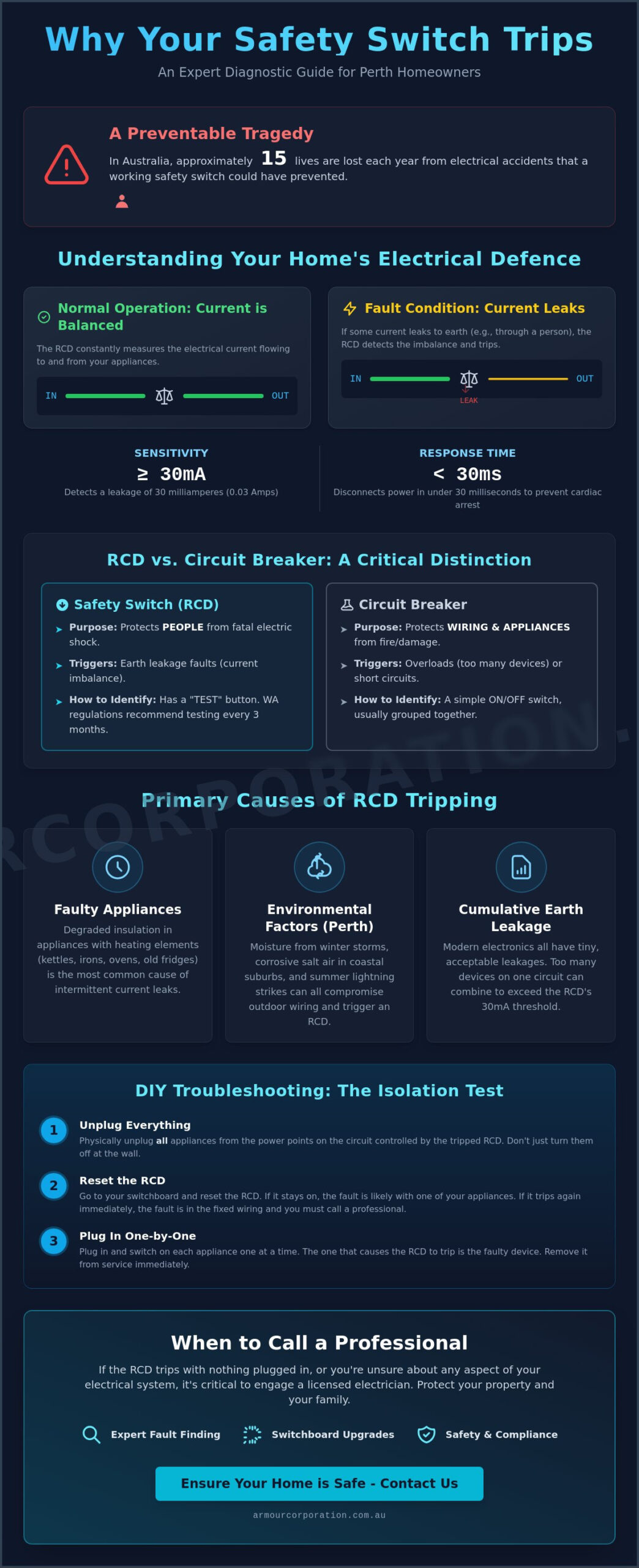
The Residual-current device (RCD) serves as the primary tactical barrier between your family and the risk of fatal electrocution. While many homeowners observe their switchboard with confusion, understanding this device is essential for maintaining a secure property. An RCD isn’t a standard switch; it’s a high-speed monitoring system designed to detect minute discrepancies in electrical flow. When your safety switch keeps tripping in your Perth home, it indicates that this system has identified a current leakage and intervened to prevent a potentially lethal event. In Western Australia, the Electricity Regulations 1947 mandate that all residential properties for sale or rent must have at least two RCDs protecting all power and lighting circuits. This legal requirement reflects the critical nature of these devices in modern risk management.
The Mechanism of Protection
This device operates with a level of precision that commands respect. It constantly measures the current flowing into a circuit against the current returning. If it detects a difference as small as 30 milliamperes, it assumes the missing electricity is leaking through a person or a faulty appliance to the earth. To prevent cardiac arrest, the RCD must disconnect the power in less than 30 milliseconds. This rapid response is the result of sophisticated engineering that prioritizes human life over continuous power supply. It’s a vigilant guardian that remains dormant until a threshold of danger is reached. Any delay in this response time could result in catastrophic physiological consequences, making the reliability of the device paramount.
RCD vs. Circuit Breaker: A Critical Distinction
Identifying the cause of a power failure requires a clear understanding of your switchboard’s components. A circuit breaker’s primary function is to protect your home’s wiring and appliances from thermal damage caused by an overload or a short circuit. It monitors the load to ensure the cables don’t overheat and cause a fire. In contrast, the RCD’s sole purpose is life preservation. You can distinguish an RCD by the presence of a “Test” button, which Western Australia’s safety standards recommend you press every three months to verify operational readiness. If your safety switch keeps tripping in your Perth home but the circuit breakers remain engaged, the issue is likely an earth leakage fault rather than a simple circuit overload. A modern Perth home requires both devices to achieve comprehensive oversight and operational compliance. This dual-layered protection ensures that both the physical infrastructure and the inhabitants remain shielded from different types of electrical failure.
Primary Causes of Safety Switch Tripping in Perth Homes
Identifying why a safety switch keeps tripping in your Perth home requires a systematic examination of your property’s electrical environment. While the RCD is designed for extreme sensitivity, its activation is rarely random. It responds to specific electrical deviations that compromise the safety of your installation. The most frequent catalyst for these disruptions is a faulty appliance, yet environmental factors unique to Western Australia often play a significant role in compromising circuit integrity. Understanding these primary causes allows for a more disciplined approach to power restoration.
Environmental Factors: The Perth Context
Perth’s unique climate introduces specific risks to outdoor electrical installations. During the winter storm season, heavy wind-driven rain can penetrate outdoor power points or lighting fixtures that aren’t perfectly sealed. In coastal suburbs such as Cottesloe or Scarborough, the high salt content in the air accelerates the corrosion of electrical contacts. This salt air, combined with the moisture from the “Fremantle Doctor” sea breeze, creates a conductive path that triggers an RCD. Additionally, the intensity of WA summer thunderstorms brings lightning strikes that can cause transient surges, leading to immediate circuit disconnection. If your system fails during these weather events, professional faultfinding and repair of electrical installations is often required to identify and seal the breach.
The Faulty Appliance Protocol
Appliances with internal heating elements, such as kettles, irons, and older refrigerators, represent the highest risk for current leakage. Over time, the insulation surrounding these elements degrades, allowing a minute amount of electricity to “leak” to the earth wire. These faults are often intermittent; a kettle might only trip the switch when it reaches a specific temperature and the metal expands. This unpredictable behavior is why a disciplined isolation test is necessary. If a device has been compromised, it will continue to trigger the safety mechanism until it’s physically removed from the circuit.
Beyond appliances and weather, physical infrastructure damage remains a serious concern. Rodent activity in roof spaces often leads to chewed cable insulation, exposing live wires to the building’s structure. In older Perth properties, the natural degradation of cable insulation over several decades can also lead to nuisance tripping. These older RCD units may become over-sensitive or fail to reset correctly, necessitating a modern replacement to maintain compliance with WorkSafe RCD requirements. Ensuring your system is regularly tested and upgraded is the only way to guarantee that your home’s primary defense remains operational and reliable.
The Challenge of Cumulative Earth Leakage
Every electronic device in a modern household exhibits a small, functional amount of “natural” leakage. This is not a fault. It’s a byproduct of internal filters designed to manage electromagnetic interference. When a safety switch keeps tripping in your Perth home without a clear appliance failure, the issue is often cumulative earth leakage. An RCD is engineered to trip when it detects a discrepancy of 30 milliamperes (mA). While a single laptop charger might only leak 1.5mA, the simultaneous operation of twenty similar devices on a single circuit can easily approach or exceed that 30mA threshold. This explains why resetting the switch often works temporarily until the next device, such as a smart television or a computer, is activated.
Modern Technology and Electrical Noise
Modern electronic loads contribute significantly to background leakage through switch-mode power supplies. These components, found in everything from smartphone chargers to LED drivers, produce high-frequency electrical noise and harmonic distortion. This noise can confuse older, less sophisticated RCD units, leading to what is professionally termed “nuisance tripping.” To maintain operational stability, Armour Corporation recommends the installation of “Type A” RCDs. Unlike standard units, these are specifically designed to handle the pulsating DC currents and high-frequency noise generated by modern tech. Without this specialized oversight, your home’s electrical barrier remains vulnerable to the complexities of modern power demands.
Mitigation Through Circuit Separation
The most effective strategy to combat cumulative leakage is a disciplined approach to circuit separation. Armour Corporation engineers focus on splitting heavily loaded circuits to reduce the total leakage current monitored by a single RCD. By distributing the load across multiple safety switches, the risk of reaching the 30mA threshold is minimized. Dedicated circuits are particularly beneficial for high-usage areas such as home offices or media rooms where IT equipment is concentrated. You should verify the integrity of your residential electrical services to ensure your switchboard configuration supports this level of precision and balanced distribution. This structural adjustment provides the long-term certainty that your system can handle the rigorous demands of a contemporary lifestyle.
Step-by-Step Troubleshooting: The Isolation Test
When a safety switch keeps tripping in your Perth home, the first phase of professional resolution involves a disciplined isolation test. This process is designed to determine whether the fault originates from a portable appliance or the property’s fixed wiring. It is a rigorous process of elimination that requires a meticulous approach to ensure accuracy. Many homeowners mistakenly believe that turning off a power point is sufficient to isolate a device. This is incorrect. To achieve true isolation, you must physically remove the plug from the socket. This action completely disconnects the appliance from both the active and neutral links, ensuring that no residual current can interfere with the RCD’s monitoring mechanism.
Executing the Professional Isolation Sequence
Success in fault finding depends on a structured sequence. Follow these steps to identify the source of the electrical instability:
- Step 1: Physical Disconnection. Walk through the entire property and physically unplug every single device from the affected circuit. This includes often overlooked items such as dishwashers, pool pumps, and outdoor lighting.
- Step 2: Reset the RCD. Return to the main switchboard and attempt to reset the safety switch. If the switch remains engaged, the fault is likely contained within one of the unplugged appliances.
- Step 3: Systematic Reintroduction. Reintroduce devices one by one. After plugging in and turning on each appliance, wait several seconds. When the RCD trips again, you have identified the compromised unit.
When the Isolation Test Fails
If the safety switch refuses to stay in the “on” position even after every device has been physically disconnected, the fault is no longer a matter of appliance maintenance. This scenario indicates a breakdown in the permanent wiring of the building. The fault may be localized within the walls, ceiling cavities, or the switchboard itself. Moisture ingress into fixed junction boxes or rodent damage to cable insulation are common culprits in these instances. At this stage, further DIY intervention is not only ineffective but poses a significant safety risk. The operational integrity of your home now requires professional diagnostic tools that can measure insulation resistance and circuit impedance.
Persistent faults within the fixed infrastructure demand immediate expert oversight. You should contact Armour Corporation for professional emergency electrician services to facilitate rapid fault mitigation and restore safety. Our team utilizes specialized testing equipment to pinpoint the exact location of underground or in-wall faults without unnecessary destruction to your property. If your isolation test has proven inconclusive, secure your home’s operational safety by requesting expert faultfinding and repair of electrical installations to resolve the underlying instability.
Professional Mitigation: Switchboard Upgrades and Fault Finding
When the isolation test proves inconclusive, the situation requires the deployment of sophisticated diagnostic equipment. Armour Corporation utilizes high-precision insulation resistance testers and dedicated RCD testers to pinpoint faults that remain invisible to the naked eye. These tools allow our technicians to measure the integrity of cable insulation and the exact millisecond response time of your safety switches. If a safety switch keeps tripping in your Perth home despite all appliances being disconnected, the fault often lies within the building’s permanent infrastructure. Legacies of older “ceramic fuse” switchboards present a high-stakes risk for Perth families, as these outdated systems were never designed to manage the complexities of modern electrical loads or provide the high-speed protection required in 2026.
The Value of a Switchboard Upgrade
A comprehensive electrical strategy often necessitates modern switchboard upgrades to replace obsolete components. Modern installations utilize individual RCD/MCB combinations, known as RCBOs, for every circuit. This configuration ensures that a fault on one circuit only isolates power to a single room rather than the entire property. This granular oversight significantly reduces the frustration of total power loss and simplifies future fault finding. Furthermore, modern switchboards provide enhanced fire protection through advanced arc-fault detection, meeting the rigorous compliance requirements of the AS/NZS 3000 standards. Upgrading your switchboard isn’t merely a maintenance task; it’s a strategic investment in the structural safety and operational mastery of your property.
Securing Your Home’s Future
Securing the long-term stability of your electrical system involves more than reactive repairs. A professional electrical safety audit provides a thorough examination of your property’s entire network, identifying potential points of failure before they manifest as dangerous faults. Regular RCD testing is a critical component of this vigilance, ensuring that your primary defenses remain capable of responding within the mandatory 30-millisecond threshold. These audits verify that every connection is secure and that your installation remains fully compliant with Western Australian safety regulations.
Operational mastery is the hallmark of a secure home. If a safety switch keeps tripping in your Perth home, don’t accept intermittent power as a standard condition. Trust the elite guardians of Perth’s electrical infrastructure to restore certainty to your environment. Armour Corporation remains committed to providing the technical precision and unwavering reliability required to maintain your home’s safety barrier. Contact us today to schedule a professional audit or to facilitate the expert faultfinding and repair of electrical installations required to secure your property’s future.
Restoring Absolute Electrical Stability to Your Property
When a safety switch keeps tripping in your Perth home, it serves as a critical alert from your electrical system’s primary defense mechanism. We’ve examined how identifying the root cause requires a disciplined approach, transitioning from basic appliance isolation to advanced professional diagnostic oversight. Maintaining an impenetrable safety barrier involves more than just resetting a switch; it requires the technical mastery of modern switchboard standards and a commitment to rigorous, regular testing.
Armour Corporation operates as an elite guardian for Western Australian households. As a family-owned business, we deploy qualified Master Electricians equipped with a 24/7 emergency response capability to ensure your home remains a secure environment. We translate complex electrical logistics into clear, value-driven protection for your family, ensuring no detail is overlooked in our pursuit of operational mastery.
Don’t allow electrical instability to compromise your peace of mind. Secure Your Home with Armour Corporation’s Expert Fault Finding and ensure your property’s defenses remain vigilant against every hazard. You deserve the absolute certainty of a professionally managed and compliant electrical installation.
Frequently Asked Questions
Why does my safety switch trip at the same time every day?
This pattern typically indicates an automated load or a programmed device activation. External factors, such as the Western Power ripple control signal used for off-peak water heating, can occasionally trigger sensitive units. You should examine pool pumps, reticulation controllers, or outdoor lighting timers as the primary suspects for these synchronized disruptions. These timed devices often develop internal faults that only manifest during their scheduled operational cycle.
Can a lightbulb blowing cause the safety switch to trip?
Yes, a failing incandescent or halogen bulb can cause a safety switch to trip. When the filament breaks, it occasionally creates a momentary arc or a path to the earth wire, which the RCD detects as a current discrepancy. While modern LED lighting is less prone to this phenomenon, faulty drivers can still trigger the safety mechanism. Replacing the damaged bulb usually restores the circuit’s stability immediately.
Is it dangerous if I keep resetting a tripping safety switch?
Repeatedly resetting a tripping switch without identifying the fault is a high-stakes risk. Each trip is a diagnostic alert indicating an active electrical hazard or insulation failure. Forcing the circuit to remain live can result in thermal damage to wiring or a potential fire. If the safety switch keeps tripping in your Perth home, you must prioritize professional fault finding over manual overrides to ensure the property remains secure.
How much does it cost to fix a tripping safety switch in Perth?
The cost of resolution depends entirely on whether the fault is a simple appliance failure or a complex infrastructure issue. Professional fault-finding services are typically billed at an hourly rate, reflecting the technical expertise and specialized diagnostic tools required. You should request a professional assessment to determine if a minor repair or a comprehensive switchboard upgrade is necessary to maintain your home’s operational compliance.
What is the difference between a safety switch and an RCD?
There is no functional difference; “safety switch” is the common term for a Residual Current Device (RCD). While a circuit breaker protects your home’s wiring from overloads, the RCD is engineered specifically to protect human life by monitoring electrical balance. In Western Australia, these devices are a mandatory legal requirement for all power point and lighting circuits in residential properties to prevent fatal electrocution.
Does a safety switch trip during a lightning storm?
Lightning strikes and severe weather events frequently cause RCD activation. Atmospheric surges can create transient imbalances that the device interprets as leakage. Additionally, moisture ingress into outdoor fittings during heavy Perth storms often creates a conductive path to earth. If the switch won’t reset after the storm passes, a permanent fault has likely developed within the installation that requires a systematic professional inspection.
Can a faulty air conditioner cause my RCD to trip?
A malfunctioning air conditioning system is a common catalyst for RCD trips. Internal compressor faults or moisture accumulation within the outdoor unit can lead to significant current leakage. Because air conditioners require high operational loads, any degradation in their internal insulation becomes immediately apparent to the safety switch. Professional inspection of the unit’s electrical components is essential to identify if the fault is localized within the appliance.
How often should I test my home safety switches?
Western Australian safety standards recommend testing your RCDs every three months by pressing the “test” button. This protocol ensures the internal mechanism remains operational and capable of disconnecting power within the required 30 milliseconds. If the device fails to trip immediately during this test, you must contact a licensed contractor to facilitate a replacement and maintain your home’s primary electrical defense.
