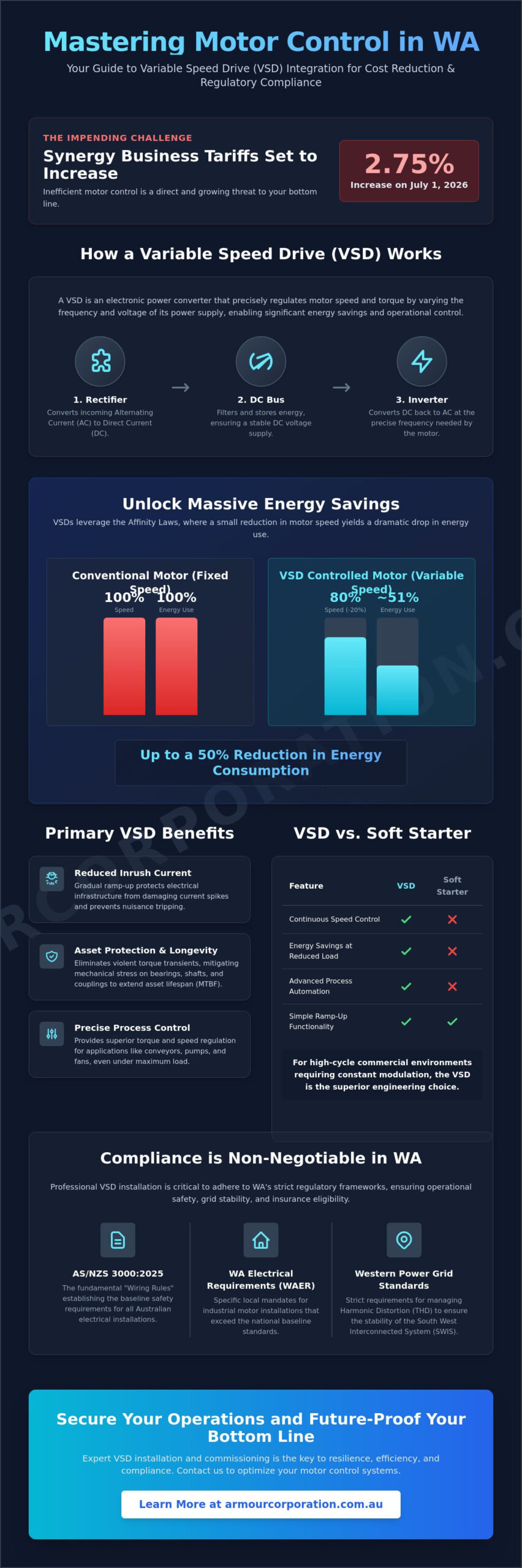
With Synergy business tariffs set to increase by 2.75% on July 1, 2026, inefficient motor control isn’t just an operational oversight; it’s a direct threat to your bottom line. Most industrial operators in Western Australia recognize that energy volatility is a constant pressure, yet the path to modernization is often obstructed by technical complexity and evolving standards. Professional VSD installation and commissioning WA serves as the primary defense against these rising costs and the risk of catastrophic equipment failure.
This guide establishes a clear framework for high-level Variable Speed Drive integration, ensuring your operations remain resilient and fully compliant with the 2025 edition of AS/NZS 3000 (Wiring Rules). You’ll gain a comprehensive understanding of how to optimize motor performance while meeting the rigorous oversight demands of Western Power. We’ll outline the precise commissioning protocols required to extend your assets’ lifespans and secure the regulatory assurance your insurance and safety protocols demand.
Key Takeaways
- Understand the strategic role of Variable Speed Drives in regulating frequency and voltage to stabilize high-stakes Perth industrial and commercial applications.
- Ensure full compliance with AS/NZS 3000 and the WA Electrical Requirements to maintain operational safety and protect insurance eligibility.
- Discover why professional VSD installation and commissioning WA is essential for verifying DC bus stability and phase rotation during the critical first-power phase.
- Learn how applying the Affinity Laws to motor control can yield up to a 50% reduction in energy consumption through precise speed adjustments.
- Implement elite engineering protocols to extend the Mean Time Between Failures for your critical motor and pump assets, ensuring long-term reliability.
Understanding VSD Technology for WA Industrial Applications
A Variable Speed Drive (VSD), also recognized technically as a Variable-Frequency Drive (VFD), is an electronic power converter that regulates motor speed by varying the frequency and voltage of the power supply. In the demanding climate of Western Australia, these devices aren’t just optional upgrades. They’re essential for operational mastery. Perth’s commercial HVAC and industrial pumping sectors rely on this technology to maintain stability under fluctuating loads. By transitioning from fixed-speed motors to variable control, facilities achieve a level of precision that direct-on-line systems can’t match.
The internal architecture of a VSD consists of three primary stages that decision-makers should understand to appreciate the value of professional VSD installation and commissioning WA:
- The Rectifier: This stage converts incoming alternating current (AC) into direct current (DC).
- The DC Bus: This component acts as a reservoir, filtering and storing energy to ensure voltage stability.
- The Inverter: This final stage converts the DC back into AC at the specific frequency required by the motor.
This sophisticated sequence allows for absolute control over mechanical output. For many facilities, modernizing their motor control is the first step in mitigating the impact of the July 2026 Synergy tariff increases. It’s a strategic move toward long-term resilience.
Primary Benefits: Efficiency and Control
One of the most critical advantages of a VSD is the substantial reduction in ‘Inrush Current’ during motor startup. By ramping up speed gradually, the system protects local electrical infrastructure from the massive current spikes that often lead to nuisance tripping. For heavy-duty applications such as conveyors and crushers, VSDs provide precise torque control. This allows for smooth operation even under maximum load. A properly commissioned VSD mitigates the mechanical stress on motor bearings by eliminating the violent torque transients associated with traditional starting methods.
VSD vs. Soft Starters: Making the Right Choice
While soft starters are effective for simple ramp-up functionality, they can’t provide the continuous speed control required in high-cycle commercial environments. A VSD maintains oversight of the motor throughout the entire operational cycle, adjusting output in real-time to meet demand. This is particularly vital when integrating drives into sophisticated automation & control systems. If your process requires constant modulation, such as maintaining pressure in a pumping station, the VSD is the superior engineering choice. Expert VSD installation and commissioning WA ensures these complex interactions remain seamless and reliable.
Compliance and Standards for VSD Installation in Western Australia
Adherence to regulatory frameworks is the cornerstone of industrial safety and operational integrity. In Western Australia, VSD installation and commissioning WA must strictly align with the 2025 edition of AS/NZS 3000, commonly known as the Wiring Rules. This standard provides the fundamental safety requirements for all electrical installations. However, WA operators must also navigate the Western Australian Electrical Requirements (WAER). These local regulations append specific mandates for industrial motor installations that exceed national baselines. Failure to observe these nuances can lead to significant penalties, including business shutdowns or the voiding of insurance policies.
Western Power enforces stringent requirements regarding harmonic distortion for any equipment connected to the South West Interconnected System (SWIS). Because VSDs are non-linear loads, they can introduce electrical noise that destabilizes the grid. Compliance requires precise engineering to ensure total harmonic distortion (THD) remains within acceptable limits. This often necessitates the installation of line reactors or passive filters. Engaging licensed industrial electrical contractors Perth ensures that your facility meets these grid connection standards while maintaining peak performance.
Mandatory Safety and Shielding Requirements
Electromagnetic Compatibility (EMC) is a critical factor in high-stakes commercial environments. Using specialized EMC-shielded cabling is mandatory to prevent high-frequency interference from disrupting sensitive data lines or communication systems. Proper earthing techniques are equally vital; they provide a low-impedance path to mitigate Radio Frequency Interference (RFI) that can otherwise plague commercial buildings. Additionally, the 2026 enforcement of RCD laws requires that every power circuit in commercial premises is protected. Sizing these RCDs and circuit protection devices correctly for VSD-controlled circuits is a task that demands expert oversight to avoid nuisance tripping caused by leakage currents.
Documentation and Certification
The administrative phase of an installation is as significant as the physical works. Every project requires the submission of a Preliminary Notice followed by a Notice of Completion to the relevant network operator. These documents serve as a legal record of the work performed. Maintaining a compliant Electrical Safety Certificate is essential for future audits and insurance claims. Armour Corporation ensures that every project meets the rigorous master electricians quality benchmarks, providing you with the documentation needed for absolute peace of mind. If you require a compliance audit of your current motor control systems, our team provides the technical vigilance necessary to secure your operations.
The Critical Phase: VSD Commissioning and Performance Testing
Physical mounting and wiring represent only half of a successful engineering project. Without expert VSD installation and commissioning WA, even the most advanced hardware remains a potential liability. Commissioning is the process that transforms a static component into a dynamic, intelligent asset. It ensures the drive communicates perfectly with the motor and the broader facility infrastructure. Neglecting this meticulous phase often leads to premature component failure or inefficient power consumption that negates the drive’s primary energy-saving benefits.
The ‘First Power’ sequence requires absolute vigilance from the attending engineer. Before the system enters full operation, we must verify correct phase rotation and DC bus stability. A stable DC bus is the foundation of drive longevity; it prevents internal capacitor stress during high-demand cycles. Once stability is confirmed, parameterisation begins. This technical process involves inputting precise motor nameplate data and load profiles into the drive’s software. Tuning the drive to these specific variables ensures the system operates at its optimal efficiency point while protecting the motor from over-torque conditions.
Modern industrial facilities require real-time oversight to maintain operational mastery. Integrating the drive with SCADA and HMI systems via high-grade data cabling Perth allows for continuous performance feedback. This connectivity provides the critical data necessary for predictive maintenance and energy reporting. It allows operators to observe drive status and adjust parameters remotely, ensuring the system remains responsive to changing production demands.
Step-by-Step Commissioning Framework
A structured approach prevents oversights and mitigates risk. Our framework starts with a rigorous visual inspection followed by insulation resistance (Megger) testing of all motor leads. These tests confirm that the installation is capable of handling the high-frequency switching of the inverter stage without leakage. Following safety verification, we perform static and dynamic motor auto-tuning. This step calibrates the flux-vector control for precise speed and torque management. Finally, we set acceleration and deceleration ramps. These settings are customized to prevent mechanical shock or the destructive ‘water hammer’ effect in pumping systems.
Harmonic Analysis and Load Testing
Post-installation verification is mandatory for grid stability and compliance. We conduct detailed harmonic surveys to ensure the installation doesn’t pollute the local network or interfere with other sensitive equipment. Testing the VSD under full load conditions allows us to monitor thermal performance and cooling efficiency in Western Australia’s often harsh ambient temperatures. Harmonic filters are verified during commissioning by measuring total harmonic distortion levels at the point of common coupling to confirm they meet Western Power’s strict requirements. This final validation ensures your VSD installation and commissioning WA provides the reliability and efficiency your operations demand.
Maximising ROI: Energy Efficiency and Equipment Longevity
Investment in VSD installation and commissioning WA is fundamentally a strategy for capital preservation. The financial logic is anchored in the Affinity Laws, which dictate the relationship between motor speed and power consumption. For centrifugal applications like fans and pumps, power consumption is proportional to the cube of the speed. This means a modest 20% reduction in motor speed results in a 50% reduction in energy use. In an environment where Synergy business tariffs are rising, these efficiencies provide a definitive hedge against escalating operational overheads.
Beyond immediate energy savings, Variable Speed Drives significantly extend the Mean Time Between Failures (MTBF) for your critical assets. By eliminating the violent mechanical shocks of direct-on-line starting, VSDs preserve the integrity of couplings, belts, and bearings. This reduction in physical wear directly translates to lower commercial electrical maintenance requirements over the lifecycle of the equipment. For Perth’s commercial sector, the payback period for a VSD retrofit often falls within 12 to 24 months, depending on the duty cycle and load profile.
Energy Savings in HVAC and Pumping
Constant-volume systems are now considered obsolete in modern Perth office fit-outs. These legacy systems waste significant energy by running motors at full speed even when demand is low. Implementing VSDs allows HVAC systems to modulate based on actual occupancy and thermal load, which is essential for achieving high NABERS ratings. High ratings are not merely badges of sustainability; they’re critical for maintaining the asset value and tenant appeal of WA commercial properties. Industry data suggests that industrial sites in Western Australia transitioning to variable control frequently observe a 30% reduction in total motor-driven energy costs.
Reducing Operational Downtime
Unscheduled downtime is the primary enemy of industrial profitability. VSDs mitigate this risk through controlled acceleration and deceleration ramps, which eliminate the mechanical fatigue caused by abrupt stops. Modern drives also serve as sophisticated diagnostic hubs. They provide real-time data that informs predictive maintenance strategies, allowing engineers to identify potential issues before they result in a total system failure. Built-in stall detection and over-torque protection act as an elite guardian for your motors, instantly disconnecting the load if a mechanical jam occurs. To secure your facility’s future, contact Armour Corporation for a comprehensive energy audit and motor control assessment.
Professional VSD Solutions: The Armour Corporation Approach
Armour Corporation defines its service through a profound commitment to elite engineering standards. Our methodology encompasses the entire project lifecycle. We begin with a rigorous site audit and transition through custom design to the final, critical execution of VSD installation and commissioning WA. This structured approach ensures that every drive integrated into your facility is optimized for the specific environmental and electrical conditions of Western Australia. We don’t just install equipment; we engineer operational resilience.
Our ‘Elite Guardian’ philosophy dictates that electrical safety is never a point of compromise. We maintain a vigilant stance on risk management, ensuring that every installation provides psychological reassurance alongside technical stability. Should operational anomalies occur, our local Perth-based team provides a rapid response. We prioritize troubleshooting and maintenance to ensure your infrastructure remains formidable against downtime. By choosing Armour Corporation, you’re securing a partner dedicated to high-stakes oversight and long-term asset protection.
Specialised Industrial Expertise
Armour Corporation possesses extensive experience with leading global brands, including ABB, Danfoss, Schneider, and WEG. This technical breadth allows us to specify the correct hardware for any application, from heavy industrial pumping to complex HVAC systems. Our work integrates seamlessly with ongoing commercial electrician Perth projects, providing a unified electrical strategy for your building. As a family-owned WA business, we understand the practicalities of operating in local heat and dust. This perspective is essential for the long-term reliability of sensitive power electronics. We translate complex operational logistics into clear, value-driven benefits for our clients.
Next Steps for Your Facility
Transitioning from legacy fixed-speed systems to modern motor control requires strategic thinking. Armour Corporation handles this evolution by managing the logistical complexities of the upgrade. We invite you to request a comprehensive VSD energy audit to identify potential efficiency gains within your current infrastructure. Our team provides a clear roadmap for your upgrade, ensuring full compliance with the latest regulations and grid requirements. For a partnership defined by reliability and technical mastery, Contact Armour Corporation for expert VSD installation and commissioning in Perth. We stand ready to optimize your operations for the 2026 energy landscape.
Securing Your Operational Future with Advanced Motor Control
Adopting variable speed technology is a strategic necessity for managing escalating energy costs and ensuring absolute regulatory compliance. This guide has detailed why precision during the installation and commissioning phases is vital to prevent mechanical fatigue and grid instability. Armour Corporation delivers specialized VSD installation and commissioning WA to ensure your infrastructure remains resilient, efficient, and fully optimized for the 2026 industrial landscape.
As a Licensed WA Electrical Contractor and a Master Electricians Member, we maintain the highest standards of technical vigilance across every project. Our team specializes in Industrial Automation & Control, providing the expert oversight necessary for high-stakes environments. We translate complex operational logistics into clear, sustainable benefits for your facility. Secure Your Operations with Expert VSD Services and gain the reassurance of professional engineering mastery. We are ready to fortify your operations with elite, high-tier electrical solutions.
Frequently Asked Questions
What is the difference between VSD installation and commissioning?
Installation involves the physical mounting and electrical wiring of the drive to the motor and power supply. Commissioning is the specialized engineering phase where software parameters are calibrated to match the specific load profile. Professional VSD installation and commissioning WA ensures that the drive is tuned for maximum efficiency and asset protection. Without this meticulous phase, the hardware cannot perform its intended function of reducing energy consumption.
Do I need a VSD if I already have a soft starter installed?
A soft starter only manages the initial ramp-up and final ramp-down of a motor to reduce mechanical shock. It cannot vary the speed of the motor during operation. If your process requires constant modulation, such as an HVAC fan or industrial pump, a VSD is necessary. The VSD provides continuous oversight of motor performance, offering energy savings and precise control that a soft starter cannot achieve.
What are the Western Power requirements for VSD harmonics in WA?
Western Power mandates that all equipment connected to the South West Interconnected System (SWIS) must comply with strict harmonic distortion limits to maintain grid stability. VSDs are non-linear loads that can pollute the network if not managed correctly. Compliance often requires the use of line reactors or passive filters. Our engineers ensure every installation meets these technical requirements to prevent interference with other sensitive equipment on the network.
How much energy can a VSD realistically save for a commercial HVAC system?
Reducing a fan or pump speed by just 20% can result in a 50% reduction in energy consumption due to the centrifugal Affinity Laws. In a typical Perth commercial HVAC system, facilities often realize overall energy savings of approximately 30% after implementing variable control. These efficiencies are critical for improving NABERS ratings and managing the impact of the July 2026 Synergy tariff increases on operational budgets.
Can a VSD be retrofitted to an existing older motor?
Most existing motors can be retrofitted with a VSD, provided their insulation is rated for the high-frequency switching of a modern inverter. Older motors may require additional protection, such as dV/dt output filters or insulated bearings, to prevent premature failure. We conduct a thorough assessment of your existing assets before recommending an upgrade to ensure the motor can withstand the electrical stresses of variable speed control.
How often should a VSD be serviced to ensure reliability?
Reliable operation requires an annual service schedule to address the specific challenges of the Western Australian environment. Technicians must inspect heat sinks for dust accumulation and verify the integrity of cooling fans. Additionally, electrical connections must be checked for tightness to prevent thermal damage. High-quality capacitors within the drive typically require a comprehensive health check every five years to maintain long-term operational stability.
What are the common causes of VSD failure in Perth’s industrial environments?
Excessive heat and dust accumulation are the primary drivers of drive failure in Perth’s industrial sectors. Clogged filters prevent effective cooling, leading to internal component stress and eventual shutdown. Power quality issues, including voltage spikes on the local grid, also pose a significant risk. Proper VSD installation and commissioning WA includes the integration of surge protection and adequate ventilation to mitigate these persistent environmental threats.
Are there any rebates available for VSD installation in Western Australia?
Western Australian businesses may access energy efficiency incentives through state-based carbon reduction initiatives or specific industrial grants. Some upgrades qualify for energy certificates that can be traded to offset capital costs. We recommend consulting with an accredited energy assessor to identify current 2026 incentives. Our team provides the technical documentation required to support these applications and demonstrate verified energy savings for your facility.
