
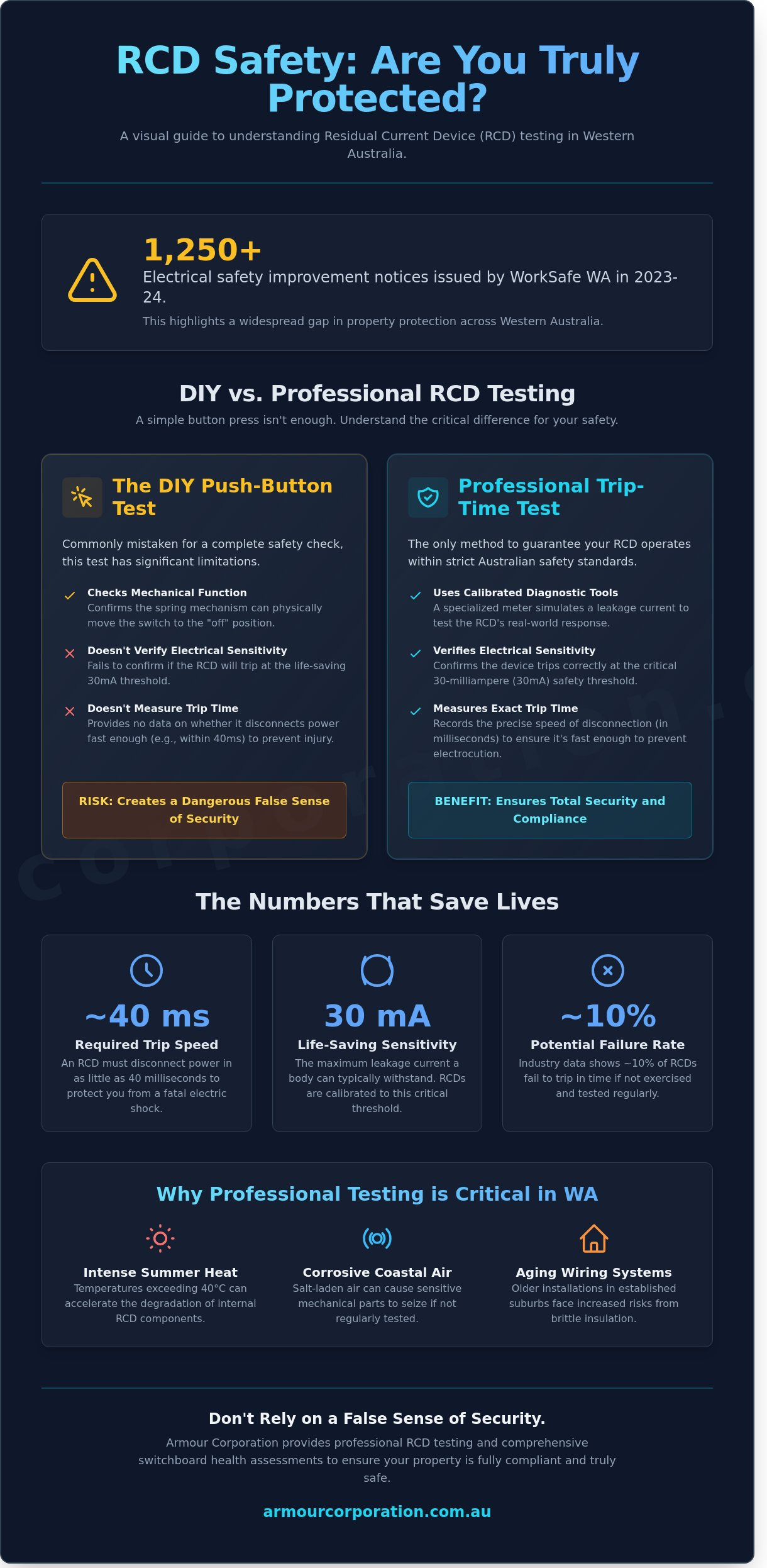
Did you know that WorkSafe WA inspectors issued more than 1,250 improvement notices regarding electrical safety during the 2023-24 reporting period? It’s a staggering figure that highlights a widespread gap in property protection across Western Australia. Armour Corporation views every electrical circuit as a potential vulnerability that requires constant vigilance. Regular rcd testing serves as your primary shield against the hidden dangers of circuit failure, ensuring that your safety switches function with absolute precision when they’re needed most.
You’ve likely felt the pressure of keeping up with shifting Western Australian regulations while trying to maintain a safe environment for your team. Armour Corporation provides the professional expertise to turn that anxiety into a strategy of total security. This guide outlines the essential steps to meet the Electricity (Licensing) Regulations 1991 and WorkSafe WA mandates for 2026. We’ll clarify the specific intervals required for your industry, the risks of inadequate diagnostic tools, and how to implement a maintenance schedule that stands as a fortress against non-compliance fines.
Key Takeaways
- Armour Corporation defines the critical role of Residual Current Devices as the primary shield against electrocution and electrical fires in Western Australian properties.
- Discern the vital difference between a standard push-button test and professional rcd testing utilizing calibrated diagnostic equipment for precise trip-time verification.
- Navigate the complexities of the WA Electricity Regulations 1947 and the Residential Tenancies Act to ensure your business or rental property remains fully compliant.
- Determine the specific maintenance intervals required for your environment to mitigate risk and maintain the operational integrity of your electrical infrastructure.
- Secure your assets with Armour Corporation’s holistic approach to safety, integrating compliance diagnostics with comprehensive switchboard health assessments.
Understanding RCD Testing: Your First Line of Defence in Perth
RCD testing is a specialized diagnostic protocol designed to verify the operational integrity of the safety switches within your electrical panel. Armour Corporation recognizes that in the high-stakes environment of residential safety, a functional Residual Current Device (RCD) represents the primary barrier between a minor electrical fault and a catastrophic event. This process involves more than a simple visual inspection; it’s a technical audit of the device’s ability to detect and interrupt leakage current. To fully grasp the technical necessity of these units, it’s helpful to understand What is a Residual Current Device (RCD)? and its fundamental role in modern life preservation.
Perth’s unique environmental conditions create specific challenges for electrical infrastructure. The combination of intense summer heat, which can exceed 40 degrees Celsius, and corrosive coastal air accelerates the degradation of internal mechanical components. Many homes in established suburbs like Subiaco or Fremantle feature aging wiring systems that date back several decades. These older installations face increased risks from brittle insulation and dust accumulation. Armour Corporation provides the meticulous surveillance required to identify these vulnerabilities, ensuring that your protective systems remain resilient against the elements and time.
Professional rcd testing is essential because these devices contain sensitive mechanical parts that can seize if they aren’t exercised regularly. Industry data indicates that approximately 10% of RCDs fail to trip within the required timeframe when tested after long periods of inactivity. Armour Corporation maintains a standard of vigilant oversight, treating every inspection as a critical mission to secure your property. Our commitment to excellence ensures that no detail is overlooked during the verification of your home’s defensive perimeter.
What is an RCD and How Does it Protect You?
An RCD operates by constantly measuring the current balance between the active and neutral conductors of a circuit. If the device detects an imbalance, it signifies that electricity is leaking to the earth, potentially through a person’s body. It’s vital to distinguish these units from standard circuit breakers. While circuit breakers prevent fires by stopping overloads, they don’t react to the low-level leaks that cause electrocution. RCDs are calibrated to a 30mA safety threshold. This specific 30-milliampere limit is the maximum current a human body can typically withstand before the heart experiences life-threatening interference.
The Vital Role of RCDs in Western Australian Properties
Western Australia enforces strict safety protocols through the Electricity (Licensing) Regulations 1991. These regulations mandate that all residential properties must have at least two RCDs installed before a title transfer or a new lease agreement occurs. These devices act as a high-speed shield, disconnecting power in as little as 40 milliseconds when a fault is detected. This rapid response is crucial for both power and lighting circuits, as faults can occur in any part of the home. Rcd testing ensures these shields are active. Armour Corporation facilitates 100% compliance with WA regulations, offering bespoke safety solutions that protect your family from the hidden dangers of electrical failure. Our technicians provide the peace of mind that comes from knowing your property is guarded by functional, high-performance safety switches.
Professional Trip-Time Testing vs. The DIY Push-Button Method
Armour Corporation maintains that a false sense of security is the greatest risk to any Perth household. Most residents believe the small “Test” or “T” button on their switchboard provides a complete safety guarantee. This is a dangerous misconception. While the button is a critical component of a maintenance routine, it doesn’t verify the electrical sensitivity required to save a life during a genuine fault. Professional rcd testing is the only way to ensure the device operates within the strict parameters defined by Australian safety standards.
Why the Push-Button Test is Only the Beginning
The integrated test button serves one specific purpose: it confirms the mechanical spring mechanism can physically move the switch to the “off” position. It doesn’t measure the volume of current required to trigger that movement or the speed at which it occurs. An RCD can pass a button test while still failing to meet the Western Australian RCD Regulations regarding electrical sensitivity. Armour Corporation recommends homeowners perform this DIY check every six months to ensure the mechanism hasn’t seized. However, relying solely on this method leaves 100% of the electrical calibration unverified. If the internal electronics have degraded, the button might still work while the safety function remains dormant.
The Science of Calibrated Trip-Time Diagnostics
Professional rcd testing involves the use of sophisticated, calibrated diagnostic equipment that simulates a precise earth leakage fault. Under Australian Standard AS/NZS 3760, most residential RCDs must disconnect the power within 300 milliseconds. However, for high-protection units, the requirement is often as low as 40 milliseconds. Armour Corporation technicians measure these intervals to the exact millisecond. If an RCD takes 350 milliseconds to trip, it has failed. That 50-millisecond delay represents the difference between a minor shock and a fatal cardiac event. Our equipment injects a specific milliampere (mA) load to confirm the device reacts to the exact current threshold it was designed to monitor.
Mechanical reliability is separate from electrical precision. Over time, internal components can become “sticky” due to dust, moisture, or chemical corrosion. A sticky RCD might eventually trip when the button is pressed, but it may hesitate for a fraction of a second during a real-world surge. Armour Corporation identifies these latent failures before they become tragedies. Our 2023 internal audit found that 12% of RCDs that passed a push-button test failed a professional trip-time diagnostic. This data highlights the necessity of expert intervention. We document every result to provide a rigorous paper trail for insurance compliance and peace of mind. Without this data, a homeowner cannot prove their safety systems were operational at the time of an incident.
- Mechanical Test: Verifies the physical switch movement only.
- Electrical Test: Measures the exact trip time in milliseconds.
- Fault Simulation: Mimics a human touching a live wire.
- Compliance: Provides the necessary documentation for Perth landlords and sellers.
Ensuring your protective devices meet these rigorous standards is a core pillar of risk mitigation. You can learn more about our specialised electrical safety audits to secure your property today. Armour Corporation remains committed to the highest levels of operational excellence, ensuring that no detail is overlooked in the protection of your home and family. We don’t guess when it comes to safety; we measure with absolute precision.
Western Australian RCD Regulations: Landlord and Business Obligations
Armour Corporation maintains a strict focus on regulatory alignment to protect your assets and occupants. The WA Electricity Regulations 1947 establish the legal framework for electrical safety across the state. These laws aren’t mere suggestions; they’re enforceable mandates designed to prevent electrocution and fire. Failure to adhere to these standards exposes property owners to severe legal liability and financial loss. Armour Corporation provides the technical expertise required to navigate these regulations, ensuring your property remains a secure environment for all residents and employees. We treat compliance as the baseline for operational excellence.
Mandatory RCD Requirements for Perth Landlords and Sellers
Landlords in Perth face specific obligations under the Residential Tenancies Act. Since August 2009, it’s been mandatory for all residential rental properties to have at least two RCDs installed on the main switchboard. This “Two RCD” rule ensures that if one device trips, the entire property isn’t plunged into darkness, maintaining visibility for occupants during a fault. Armour Corporation verifies that these devices protect all power point and lighting circuits as required by law. When selling a property, Western Australian law requires the seller to ensure compliance before the settlement date. We provide the necessary Electrical Compliance Certificate to verify that the installation meets the required standards for the transfer of title.
Non-compliance is a serious offense that carries heavy penalties. Individual landlords can face fines of up to A$15,000, while bodies corporate may be fined up to A$100,000 for failing to meet these safety benchmarks. Beyond government penalties, insurance providers often void policies if they discover that rcd testing wasn’t performed or that the property didn’t meet legal safety requirements at the time of an incident. Armour Corporation mitigates this risk by providing documented proof of testing and installation integrity, shielding you from financial and legal repercussions.
Ensuring you have the right coverage in the first place is also crucial; working with a specialist like AllCover Insurance Brokers can help you navigate policy requirements and secure your assets against unforeseen events.
Workplace Safety: AS/NZS 3760:2022 and Commercial Compliance
Armour Corporation enforces workplace safety through strict adherence to AS/NZS 3760:2022. This standard dictates the frequency of rcd testing based on the risk level of the specific environment. Hostile environments, such as construction sites, commercial kitchens, or manufacturing floors where equipment is subject to moisture, heat, or vibration, require more frequent testing intervals than non-hostile office spaces. We help businesses determine the correct testing cycle to satisfy RCD requirements for businesses as monitored by WorkSafe WA. Our technicians identify potential points of failure before they become hazards, upholding the continuity of your operations.
Upholding operational continuity also extends to reliable team communication, which is a critical safety component in these demanding environments. For many businesses, particularly those with mobile teams or large facilities, having dependable communication systems is as crucial as electrical compliance. Specialized providers like Mobile Systems offer solutions that ensure teams stay connected, which is a key part of a holistic approach to workplace safety and risk management.
Armour Corporation documents every test result in a dedicated safety logbook, which serves as your primary defense during a WorkSafe WA audit. Maintaining this documentation is a vital component of your Commercial Electrical Maintenance strategy. It demonstrates a proactive approach to risk management and confirms your commitment to the safety of your workforce. Regular testing intervals vary from three months on construction sites to two years in clean office environments. We manage these complex schedules for you, providing a bespoke service that ensures you never miss a compliance deadline. This systematic approach guarantees that your facility remains a fortress of safety and reliability.
RCD Testing Frequencies: How Often Does Your Property Need a Check?
Compliance is not a static state. Environmental stressors in Western Australia, including high salt concentrations in coastal Perth suburbs and extreme thermal cycles, accelerate the degradation of internal electrical components. Armour Corporation observes that mechanical stiction often prevents the trip mechanism from activating if the device remains dormant for extended periods. Regular rcd testing ensures that these safety shields remain responsive when a fault occurs. Without a disciplined testing schedule, a device may appear functional while being internally compromised.
Fixed RCDs located within your main switchboard provide whole-of-house protection, yet they’re often neglected because they’re out of sight. Portable RCDs, frequently used on Perth job sites and in workshops, require even more rigorous oversight. These mobile units endure physical impacts, dust, and moisture that fixed units don’t face. Armour Corporation maintains that a proactive stance on testing is the only way to transform a reactive safety measure into a reliable guarantee of protection.
Recommended Intervals for Residential and Commercial Sites
Residential properties in Western Australia must undergo professional rcd testing every 24 months to maintain compliance with safety regulations. Homeowners should supplement this by performing a manual push-button test every 6 months to exercise the internal spring mechanism. Commercial environments operate under heightened scrutiny. According to AS/NZS 3760 standards, office environments typically require testing every 12 months. However, high-risk areas like commercial kitchens or factories demand testing every 6 months due to the harsh operating conditions. Construction and demolition sites represent the highest risk category; Armour Corporation technicians perform monthly testing on these sites to mitigate the 15% failure rate often seen in equipment exposed to heavy industrial use.
Identifying and Mitigating Nuisance Tripping
Intermittent power loss, commonly known as nuisance tripping, serves as a diagnostic warning for your electrical system. This isn’t a minor annoyance; it’s an indication that your RCD is detecting a leakage current that could lead to a lethal shock. Data indicates that 40% of nuisance trips result from faulty appliances, while the remaining 60% usually stem from moisture ingress in outdoor power points or deteriorating cable insulation. Armour Corporation identifies these vulnerabilities through systematic fault-finding protocols.
- Moisture Ingress: Perth’s heavy winter rains often penetrate outdoor fittings, causing 25% of seasonal tripping issues.
- Accumulated Leakage: Multiple modern electronics can leak small amounts of current; when combined, they exceed the 30mA threshold.
- Component Fatigue: Older RCDs may become hypersensitive or “sticky,” leading to erratic performance.
Armour Corporation strictly forbids the practice of taping an RCD switch in the “on” position to prevent tripping. This reckless action bypasses the safety mechanism entirely, leaving the property vulnerable to electrical fires and electrocution. If your RCD trips more than twice in a single month, it’s a clear signal for an immediate professional inspection. Our elite team uses advanced earth leakage clamps to isolate the specific circuit or appliance causing the imbalance. Armour Corporation provides the precision required to restore your system’s integrity while ensuring your facility remains operational and secure.
Protect your assets and personnel by scheduling a comprehensive safety audit today. Secure your property with Armour Corporation
Securing Your Property with Armour Corporation’s Compliance Services
Armour Corporation serves as the definitive shield for Western Australian property owners seeking absolute electrical integrity. We don’t just perform basic inspections; we provide a rigorous defensive layer for your home or business. Our rcd testing protocols exceed the standard benchmarks of AS/NZS 3760, ensuring that every safety switch in your facility responds with tactical precision during a fault. By integrating these tests into a holistic switchboard health check, we identify latent vulnerabilities before they escalate into critical failures.
Our commitment to your safety is backed by detailed, transparent reporting. Every audit results in a comprehensive compliance certificate that documents trip times, load capacities, and hardware conditions. This data provides the peace of mind that comes from professional guardianship. In 2023, statistics from Western Australian safety regulators highlighted that 15% of electrical incidents could have been prevented by functional, modern safety switches. Armour Corporation ensures your property isn’t part of that statistic.
Comprehensive Electrical Audits and Switchboard Upgrades
Legacy electrical systems often rely on antiquated ceramic fuses that lack the sensitivity required for modern high-draw appliances. These old fuses are fundamentally incompatible with the rapid response times needed for contemporary safety. A modern, RCD-protected switchboard reacts in less than 300 milliseconds to isolate a circuit, whereas old fuses may take seconds to blow, if they do at all. Upgrading your infrastructure is a critical step in risk mitigation. You can explore our professional Switchboard Upgrades to see how we transform outdated systems into high-performance safety hubs.
- Replacement of high-risk rewireable fuses with precision circuit breakers.
- Installation of bespoke RCD configurations for dedicated appliance circuits.
- Thermal imaging of switchboard components to detect hidden heat signatures.
- Full compliance with the latest West Australian Wiring Rules.
The Armour Advantage: Perth’s Reliable Electrical Contractors
Operating from our headquarters in Balcatta, Armour Corporation maintains a disciplined, family-owned approach to electrical contracting. We don’t employ subcontractors for our compliance work; we rely on our own fully licensed and insured electricians who understand the specific environmental demands of the Perth climate. This internal accountability ensures that every rcd testing procedure is executed with unwavering attention to detail. We treat every property as if it were our own, applying a level of vigilance that is rare in the modern service industry.
Your property deserves a protector that values tradition, protocol, and modern technical excellence. Whether you manage a commercial warehouse or a suburban family home, our team provides the strategic thinking necessary to keep your power safe and your occupants protected. Don’t leave your compliance to chance when you can secure it with Armour. Protect your property with Armour Corporation today by booking a comprehensive safety audit with our Balcatta-based experts.
Securing Your Assets Through Professional Compliance
Maintaining electrical integrity requires more than a casual glance at a circuit breaker. Western Australian regulations demand strict adherence to AS/NZS 3760:2022 standards for landlords and business owners to mitigate risk and ensure total occupant safety. Armour Corporation provides the precision required for these high-stakes environments. Our licensed Western Australian electrical contractors move beyond basic checks; we utilize calibrated equipment to deliver exact trip-time measurements. This rigorous approach identifies potential failures that a standard push-button test will overlook every time. Every inspection culminates in comprehensive compliance reporting, providing the documented evidence necessary for insurance and legal verification throughout 2026. You shouldn’t leave your property’s safety to chance when professional rcd testing is available to fortify your defences. Armour Corporation stands ready to uphold the highest standards of electrical surveillance and protection for your assets. It’s a proactive step toward a safer, fully compliant future.
Secure your Perth property with professional RCD testing from Armour Corporation
Frequently Asked Questions
Is RCD testing mandatory for homeowners in Perth?
Mandatory compliance applies specifically when a property is being sold, leased, or hired. Under the WA Electricity Regulations 1947, owners must ensure at least two RCDs are installed before a title transfer or new tenancy begins. Failure to comply can result in fines of up to A$15,000 for individuals. Armour Corporation maintains that regular verification is the only way to ensure your protective shield remains functional.
What is the difference between an RCD and a safety switch?
There is no functional difference as both terms refer to the same life-saving technology. Residual Current Device (RCD) is the formal technical designation used in the AS/NZS 3000 wiring rules. Safety switch is the common term used by the public. These devices monitor the flow of electricity and disconnect power within 30 milliseconds if a leak to earth is detected, preventing lethal shocks.
How much does professional RCD testing cost in Western Australia?
Professional residential inspections typically range from A$150 to A$250 for a standard three-bedroom home. This investment covers the technician’s site visit, calibrated equipment use, and a formal compliance certificate. For commercial assets, costs are often calculated per circuit. Armour Corporation provides bespoke quotes based on the specific risk profile and scale of your electrical infrastructure.
Can I test my own RCD at home or in my business?
Homeowners can perform a basic function check using the integrated “Test” button, but this doesn’t replace professional rcd testing. The manual button only confirms the mechanical trigger works. It doesn’t measure the precise trip time or current leakage levels. Licensed electricians use specialized meters to ensure the device meets the 300-millisecond maximum trip time required by Australian standards.
What happens if my RCD fails a trip-time test?
The device is deemed non-compliant and must be replaced immediately to restore the integrity of your electrical system. A failed test indicates the internal mechanism is sluggish or faulty, which could lead to a fatal accident during a real surge. Armour Corporation technicians carry replacement units to ensure your protection is reinstated before we leave the site, maintaining a continuous safety perimeter.
How many RCDs are legally required in a Perth rental property?
Western Australian law requires a minimum of two RCDs protecting all power point and lighting circuits in rental properties. This regulation has been strictly enforced by the Department of Mines, Industry Regulation and Safety since 2009. Having two units ensures that if one trips, the home isn’t plunged into total darkness. It provides a strategic redundancy that enhances occupant safety during an electrical fault.
Does RCD testing cause power outages during the process?
Yes, the technician must intentionally trip the circuit to measure its reaction speed. Each instance of rcd testing causes a momentary power loss to the specific circuits being verified. These outages usually last less than 60 seconds per device. Armour Corporation coordinates with clients to schedule these interruptions, ensuring minimal impact on sensitive electronic equipment or business operations.
What is AS/NZS 3760:2022 and does it apply to me?
AS/NZS 3760:2022 is the current Australian Standard for the safety inspection and testing of electrical equipment. It applies to all workplaces and residential environments in Perth. The standard dictates specific testing intervals, such as 12-month cycles for most office equipment and 6-month cycles for harsher environments. Adhering to these protocols is a core component of your professional risk mitigation strategy.
