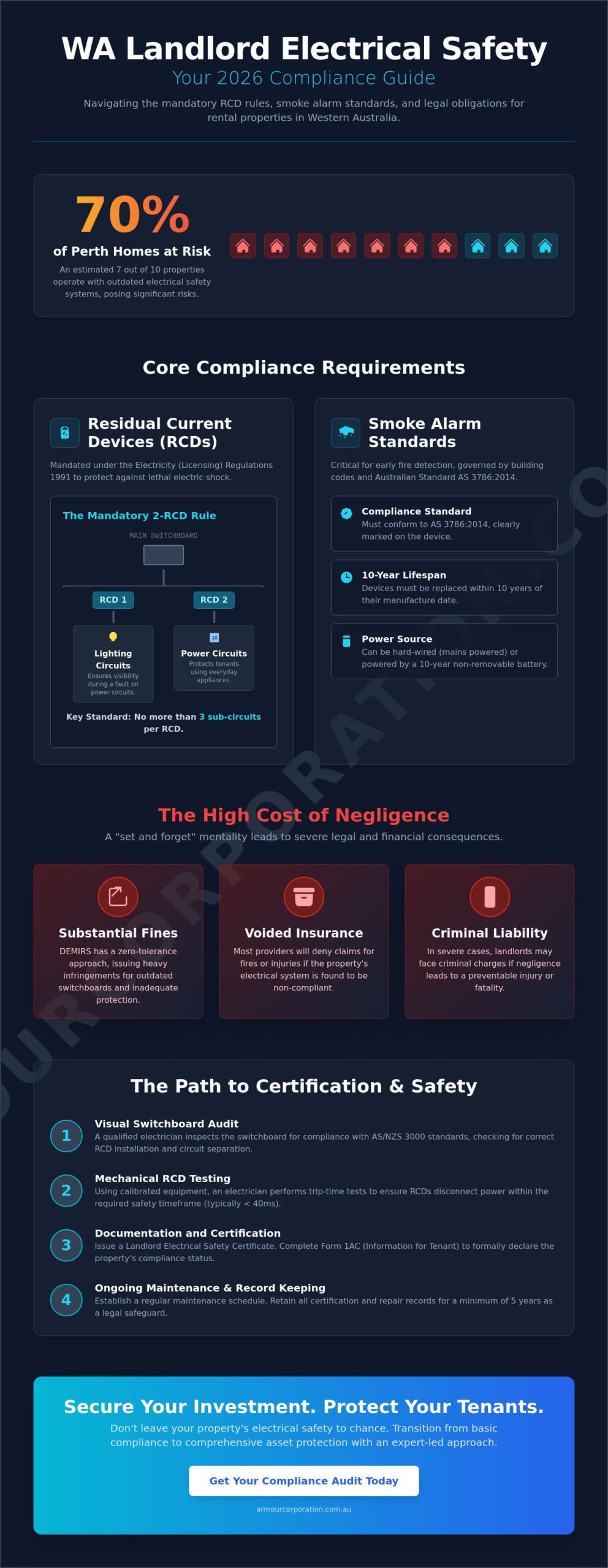
Approximately 70% of homes in Perth are estimated to be operating with outdated electrical safety systems, leaving many property owners exposed to significant legal and physical risks. You likely find the complexities of the “2-RCD rule” and the threat of heavy non-compliance fines to be a constant source of concern. It’s a heavy responsibility to manage, especially when finding a qualified electrician who truly understands Western Australia’s specific legislative framework feels like a challenge.
Our professional oversight provides the strategic framework you need to master the 2026 requirements for a landlord electrical safety certificate WA, ensuring your investment remains secure and your tenants remain safe. This guide details the mandatory RCD configurations, the current smoke alarm standards under AS 3786:2014, and the precise steps required to maintain operational mastery over your property’s electrical integrity. By following this disciplined approach, you can achieve total legal compliance and significantly lower your insurance risk through expert, vigilant maintenance.
Key Takeaways
- Understand the critical legal intersection between the Residential Tenancies Act 1987 and the Electricity (Licensing) Regulations 1991 to ensure full statutory compliance.
- Secure a valid landlord electrical safety certificate WA by strictly adhering to the mandatory 2-RCD rule and AS/NZS 3000 switchboard standards.
- Learn the technical requirements of the certification process, including visual switchboard audits and mechanical RCD trip-time testing using calibrated equipment.
- Identify the legal and financial risks of a “set and forget” mentality and master your obligations for urgent electrical repairs under Western Australian law.
- Transition from basic compliance to comprehensive asset protection with an engineering-led approach to risk mitigation and tenant safety.
Understanding Landlord Statutory Obligations in Western Australia
Legislative compliance in Western Australia isn’t a matter of choice; it’s a structural requirement of property management. The legal framework governing rental properties is found at the intersection of the Residential Tenancies Act 1987 and the Electricity (Licensing) Regulations 1991. These statutes dictate that a property must be fit for habitation, which specifically includes meeting modern electrical requirements. A landlord electrical safety certificate WA serves as the definitive record of a property’s technical integrity. It’s a professional verification that confirms a licensed electrician has audited the installation and found it compliant with current safety mandates.
Property owners hold a non-negotiable duty of care to protect tenants from electrical hazards like arc flashes or lethal shocks. This responsibility isn’t static. It requires active oversight and periodic verification. Negligence in this area carries severe consequences that extend beyond simple administrative penalties. Fines for non-compliance are substantial, but the secondary risks are often more damaging. Most insurance providers will void a policy if a fire or injury occurs in a non-compliant property. In the most severe cases of negligence, landlords can face criminal liability if their failure to maintain electrical safety standards leads to a preventable fatality.
The Role of the Department of Energy, Mines, Industry Regulation and Safety (DEMIRS)
The Department of Energy, Mines, Industry Regulation and Safety (DEMIRS) serves as the primary regulatory authority responsible for monitoring and enforcing electrical compliance and licensing standards across Western Australia. In 2026, DEMIRS has shifted toward a more rigorous enforcement model compared to the standards of the previous decade. This evolution reflects a zero-tolerance approach to outdated switchboards and inadequate circuit protection. Their inspectors have the authority to issue rectification orders and substantial infringements if a property fails to meet the mandated 2-RCD rule or modern smoke alarm requirements.
Documentation: Form 1AC and Tenancy Agreements
Documentation is the cornerstone of risk mitigation. In Western Australia, Form 1AC (Information for Tenant) is a mandatory disclosure that must be provided to every new tenant before they occupy the premises. This document requires landlords to explicitly state whether the property is equipped with at least two RCDs and compliant smoke alarms. It’s a transparent declaration of safety that binds the landlord to their statutory obligations.
Maintaining a landlord electrical safety certificate WA is only one part of the process; you must also keep detailed maintenance logs. If an RCD fails a push-button test or a smoke alarm reaches its ten-year expiration date, the correction must be documented. We recommend that property owners retain all certification records for a minimum of five years. This archive provides an impenetrable barrier of evidence should a compliance audit or insurance claim ever arise. It transforms safety from a vague concept into a verifiable operational asset.
The Technical Core: RCD and Smoke Alarm Standards
The technical foundation of a landlord electrical safety certificate WA rests on the precise configuration of Residual Current Devices (RCDs) and smoke detection systems. AS/NZS 3000, known as the Wiring Rules, serves as the definitive benchmark for every rental property switchboard in Western Australia. Compliance isn’t achieved by simply having safety switches present; it requires a disciplined adherence to circuit distribution and hardware specifications. Every component must function as part of a high-stakes safety barrier designed to prevent electrical fires and fatal shocks.
The mandatory 2-RCD rule is a central requirement of the Electricity Regulations 1947. By mandating at least two units, the law ensures that a single fault doesn’t plunge an entire residence into darkness. Lighting and power circuits must be protected independently. This redundancy is vital for tenant safety, allowing for continued illumination while a faulty power circuit is isolated. Current 2026 standards dictate that no more than three final sub-circuits should be connected to a single RCD. These WA government regulations provide a framework for high-level risk reduction and property protection.
Residual Current Devices (RCDs): More Than Just a Switch
An RCD is a high-precision monitoring tool designed to detect earth leakage in milliseconds. It constantly measures the balance of electrical current. If it detects a discrepancy that could indicate a life-threatening shock, it disconnects the power instantly. Modern appliances and high-load systems often require specific RCD configurations to function without nuisance tripping. This phenomenon occurs when an RCD is poorly matched to the circuit’s load or environment. Professional installation ensures that your safety systems are both vigilant and stable. For property owners seeking to maintain this level of operational mastery, engaging experts for comprehensive electrical services is a strategic necessity.
Smoke Alarms and AS 3786 Compliance
Smoke alarm standards are equally rigorous. Every rental property must feature alarms that comply with AS 3786:2014. These units must be less than 10 years old; anything beyond this timeframe is considered a failure of compliance. Photoelectric sensors are now the industry requirement. They’re more effective at detecting smouldering fires than older ionisation models. While long-life lithium batteries are permitted in specific older dwellings where ceiling access is impossible, the standard for modern Perth rentals remains hard-wired, mains-powered units with battery backups.
In multi-level residences, interconnection is mandatory. If one alarm detects smoke on the ground floor, all alarms throughout the property must sound simultaneously. This ensures audibility in all sleeping areas, regardless of where the fire originates. Placement is a strategic exercise. Alarms must be positioned away from dead air spaces and drafty areas to ensure they function with absolute reliability when seconds matter most. Securing a landlord electrical safety certificate WA requires more than a visual check; it demands a technical audit of these interconnected systems to guarantee they meet the elite standards of Western Australian law.
The Electrical Safety Inspection and Certification Process
The certification process is a methodical examination of a property’s electrical infrastructure. It’s not a superficial walkthrough; it’s a technical validation of safety that requires a disciplined operational approach. Securing a landlord electrical safety certificate WA requires a licensed contractor to perform a series of rigorous tests using calibrated equipment. These procedures ensure that every safety barrier is operational and capable of performing under fault conditions. This systematic oversight transforms a legal obligation into a verifiable asset of property management.
What Happens During a Professional Audit?
An audit begins with a visual inspection of the main switchboard and visible wiring throughout the premises. The electrician identifies any degraded components or recalled materials, such as the hazardous Infinity cable that plagued many Australian properties. A critical phase involves testing the integrity of the earthing system, which serves as the primary path for fault currents to safely dissipate. The RCD trip-time test parameters require the device to disconnect power within 300 milliseconds at its rated tripping current to meet Australian standards. This precision ensures that any leakage is neutralized before it becomes lethal. Verification of smoke alarms follows, involving decibel measurements to ensure the alarm is audible in sleeping quarters and checking manufacture dates to confirm they fall within the ten-year compliance window.
Professional audits offer a level of scrutiny that DIY checks cannot replicate. While a tenant can push a test button, only a professional can verify the actual speed and sensitivity of a safety switch. This level of electrical safety for landlords is a standard recognized across Australia as the baseline for responsible property management. It provides a definitive baseline of safety that protects the physical asset and the lives within it. By identifying hidden faults before they escalate into emergencies, these inspections provide the quiet confidence that comes from expert guidance.
Interpreting the Notice of Completion
Upon successful inspection, the electrician issues a Notice of Completion, which is the formal name for the landlord electrical safety certificate WA. This document carries significant legal weight. It’s a signed declaration by a licensed professional that the installation meets the Electricity (Licensing) Regulations 1991. If a liability claim ever arises, this certificate serves as your primary defense, proving that you exercised your statutory duty of care. It’s important to distinguish this from a general maintenance report; the safety certificate is a compliance document that specifically addresses the mandatory life-safety systems required by Western Australian law. Maintaining these records creates an impenetrable barrier of documentation that supports your long-term investment strategy.
Risk Mitigation: Ongoing Maintenance vs. One-Off Checks
Electrical safety is a continuous operational requirement, not a static achievement. Many property owners fall into the “set and forget” fallacy, assuming a one-time landlord electrical safety certificate WA provides permanent protection. This is a dangerous misconception. Electrical components degrade over time due to environmental factors, mechanical wear, and load stress. To maintain absolute stability and operational mastery, we recommend a disciplined testing schedule: annual smoke alarm inspections and biennial RCD audits. These intervals ensure that your safety barriers remain functional and ready to respond to faults.
Under Western Australian law, electrical faults that compromise tenant safety are classified as urgent repairs. Landlords must respond with speed to rectify these hazards, often within 24 to 48 hours of being notified. Vigilance is the only effective defense against property loss and legal liability. You should remain observant for early warning signs that indicate system fatigue. These include flickering lights, buzzing sounds from the switchboard, or outlets that feel warm to the touch. Addressing these symptoms early prevents catastrophic failure and maintains the integrity of your investment.
Tenant Responsibilities in Electrical Safety
Tenants play a critical role in the property’s safety ecosystem. They have a statutory duty to report any electrical faults to the landlord or property manager immediately in writing. We encourage landlords to educate tenants on the manual “push button” RCD test, which should be performed every three months. This simple action verifies the mechanical operation of the safety switch between professional audits. It’s essential to clarify that tenant-led electrical modifications or “DIY” repairs are strictly prohibited. Any unauthorized work compromises the landlord electrical safety certificate WA and creates unmanaged risk for all parties involved.
Managing Older Perth Properties
Heritage homes and pre-1980s residences in Perth present unique technical challenges. These structures often feature outdated wiring that wasn’t designed for the high-load demands of modern air conditioning, high-end appliances, and EV charging. For these assets, switchboard upgrades are a strategic necessity rather than an optional improvement. Older ceramic fuses must be replaced with modern circuit breakers and RCDs to meet current 2026 standards. Planning for a full rewiring should be viewed as a long-term capital improvement strategy to preserve property equity and ensure tenant safety.
Maintaining this level of oversight requires a professional partner dedicated to high-stakes risk management and technical precision. You can secure your investment and ensure total peace of mind by scheduling your next compliance audit with Armour Corporation today.
Armour Corporation: Elite Guardians of Your Rental Assets
Armour Corporation operates as the definitive authority in Western Australian electrical risk management. Our organization is built upon deep-rooted family values, yet we execute our mission with the technical precision of an elite security force. We view the landlord electrical safety certificate WA not as an administrative hurdle, but as a critical component of a disciplined asset protection strategy. This engineering-led approach to electrical services ensures that every rental property under our watch is fortified against failure and legal vulnerability.
Our commitment to absolute stability and operational mastery is evident in every inspection we conduct. We provide comprehensive compliance packages specifically designed for Perth property managers who require high-level oversight for their portfolios. By integrating technical expertise with a serious, professional tone, we offer the quiet confidence that comes from knowing your assets are being monitored by industry leaders. We don’t settle for surface-level checks; we dig into the technical logistics to ensure every circuit meets the rigorous standards of 2026 legislation.
Why Sophisticated Landlords Choose Armour
Professional property investors understand that precision is the only way to mitigate high-stakes risks. Armour Corporation utilizes the latest calibrated diagnostic technology to perform precision testing that goes far beyond the basic requirements. Our detailed reporting provides a level of transparency that exceeds standard regulatory expectations, giving you a clear, value-driven view of your property’s health. When complex faults are identified, our clients have direct access to master electricians who specialize in sophisticated mitigation strategies. This elite level of service ensures that even the most challenging heritage or high-load properties remain stable and compliant.
Securing Your Property for 2026
Managing a multi-property portfolio requires a streamlined approach to compliance that leaves no room for error. Armour Corporation has developed a proactive notification system that alerts you to upcoming compliance deadlines well in advance, preventing the risk of expired certifications. We handle the logistics of the landlord electrical safety certificate WA with military-grade efficiency, coordinating with tenants and property managers to minimize disruption while maximizing safety. Our goal is to provide an impenetrable barrier of protection around your investments, translating complex operational requirements into psychological reassurance for you and your tenants.
Don’t leave your property’s safety to chance or casual providers. Secure the elite oversight your investments deserve. Secure your landlord electrical safety certificate with Armour Corporation today.
Securing Your Property Assets Through Disciplined Compliance
Maintaining electrical compliance in Western Australia requires a disciplined framework of risk mitigation that protects both human life and property equity. You’ve mastered the technical requirements of the mandatory 2-RCD rule and the rigorous standards for interconnected smoke alarms. A valid landlord electrical safety certificate WA serves as your primary defense against liability; it confirms that your property meets the elite standards of the Electricity Regulations 1947. Armour Corporation provides the vigilant oversight necessary to transform these complex logistics into absolute certainty for your portfolio.
As a Master Electricians member and specialist in WA-specific regulatory compliance, our team delivers engineering-grade fault finding and reporting that exceeds standard industry practices. We ensure your assets remain stable, compliant, and fully insured. Request a Professional Compliance Audit from Armour Corporation to fortify your property against unmanaged risks. Taking these proactive steps today reinforces your commitment to safety and secures the long-term viability of your investments.
Frequently Asked Questions
Is an electrical safety certificate mandatory for all rentals in WA?
Yes, an electrical safety certificate is mandatory for all residential rental properties in Western Australia. Under the Electricity Regulations 1947, landlords must ensure their properties meet specific safety standards before a new lease is signed or an existing one is renewed. This documentation serves as formal verification that the mandatory RCDs and smoke alarms are correctly installed and operational.
How many RCDs does a rental property need in Western Australia?
Western Australian law requires at least two Residual Current Devices (RCDs) to be installed in every rental property. This configuration is designed to protect all lighting and power circuits independently, ensuring that a fault in one circuit doesn’t leave the entire premises in darkness. Current regulations also specify that no more than three final sub-circuits should be connected to a single RCD.
Can I test the smoke alarms and RCDs myself to save on costs?
Landlords and tenants are encouraged to perform basic “push button” tests every three months to verify mechanical function. However, these checks don’t fulfill your legal obligations for professional certification. A valid landlord electrical safety certificate WA can only be issued by a licensed electrician who uses calibrated diagnostic equipment to confirm precise trip times and sensor sensitivity.
What happens if my rental property fails an electrical safety inspection?
If a property fails an inspection, the electrician will provide a report detailing the specific areas of non-compliance. You must rectify these issues before a certificate can be issued. Because electrical faults are classified as urgent repairs under the Residential Tenancies Act, these corrections must be prioritized to maintain your property’s legal status and ensure tenant safety.
How long is a Landlord Electrical Safety Certificate valid for in WA?
The law requires that a property be compliant at the start of every tenancy. While the landlord electrical safety certificate WA doesn’t have a fixed expiration date, the electrical contractor must provide the document within 28 days of work and retain a copy for five years. We recommend professional testing every two years for RCDs and annually for smoke alarms to ensure absolute stability.
Do I need to upgrade my switchboard to get a safety certificate?
A switchboard upgrade is required only if your current installation is non-compliant or structurally degraded. Many older Perth homes with ceramic fuses cannot accommodate the mandatory 2-RCD rule or the load demands of modern appliances. Upgrading to a modern switchboard with circuit breakers is a strategic necessity for meeting current AS/NZS 3000 standards and securing your certification.
What is the difference between a hard-wired and a battery smoke alarm for rentals?
Hard-wired smoke alarms are connected directly to the property’s mains power and include a battery backup for reliability during outages. Battery-only alarms, specifically those with long-life lithium batteries, are only permitted in older dwellings where structural barriers make mains wiring impossible. All alarms must comply with AS 3786:2014 and be replaced every ten years to remain compliant.
Does the 2-RCD rule apply to apartments and strata properties in Perth?
The 2-RCD rule applies universally to all residential rental premises in Western Australia, including strata-titled apartments and villas. There are no exemptions based on the building type or ownership structure. Every individual unit must have its own compliant RCD protection on all lighting and power circuits before it can be legally leased to a tenant.
