Why do two identical 6.6kW solar quotes in Subiaco often differ by more than A$3,500 despite using hardware that appears identical on paper? This discrepancy represents the critical gap between a high-risk gamble and a secure energy investment. Armour Corporation observes that Perth property owners are increasingly vigilant regarding the “solar cowboy” phenomenon and the technical complexities of Western Power regulations. You deserve a solution that prioritizes the long-term mitigation of energy costs over the false economy of the lowest bid.
Armour Corporation has developed this definitive guide to clarify exactly how much to install solar panels Perth residents and businesses should expect to pay in 2026. We provide a rigorous assessment of current market rates and the integrity of modern engineering standards. This analysis ensures you possess the data required to secure a bespoke system that maintains its performance for 20 years or more. You’ll gain a clear understanding of WA-specific rebates, export limit compliance, and the precise ROI metrics that define a successful energy strategy.
Key Takeaways
- Analyze current market conditions to determine exactly how much to install solar panels Perth homeowners should budget for high-performance 6.6kW systems in 2026.
- Identify the critical role of N-Type and TOPCon technologies in maintaining system integrity and efficiency within Western Australia’s extreme thermal environments.
- Navigate the complexities of Federal STC rebates and the Distributed Energy Buyback Scheme (DEBS) to maximize your long-term return on investment.
- Ensure operational compliance by understanding Western Power’s 5kVA inverter capacity limits and the latest Emergency Solar Management (ESM) protocols.
- Learn how Armour Corporation utilizes bespoke engineering and meticulous design to outperform generic solar installations for superior energy independence.
Current Landscape of Solar Installation Costs in Perth (2026)
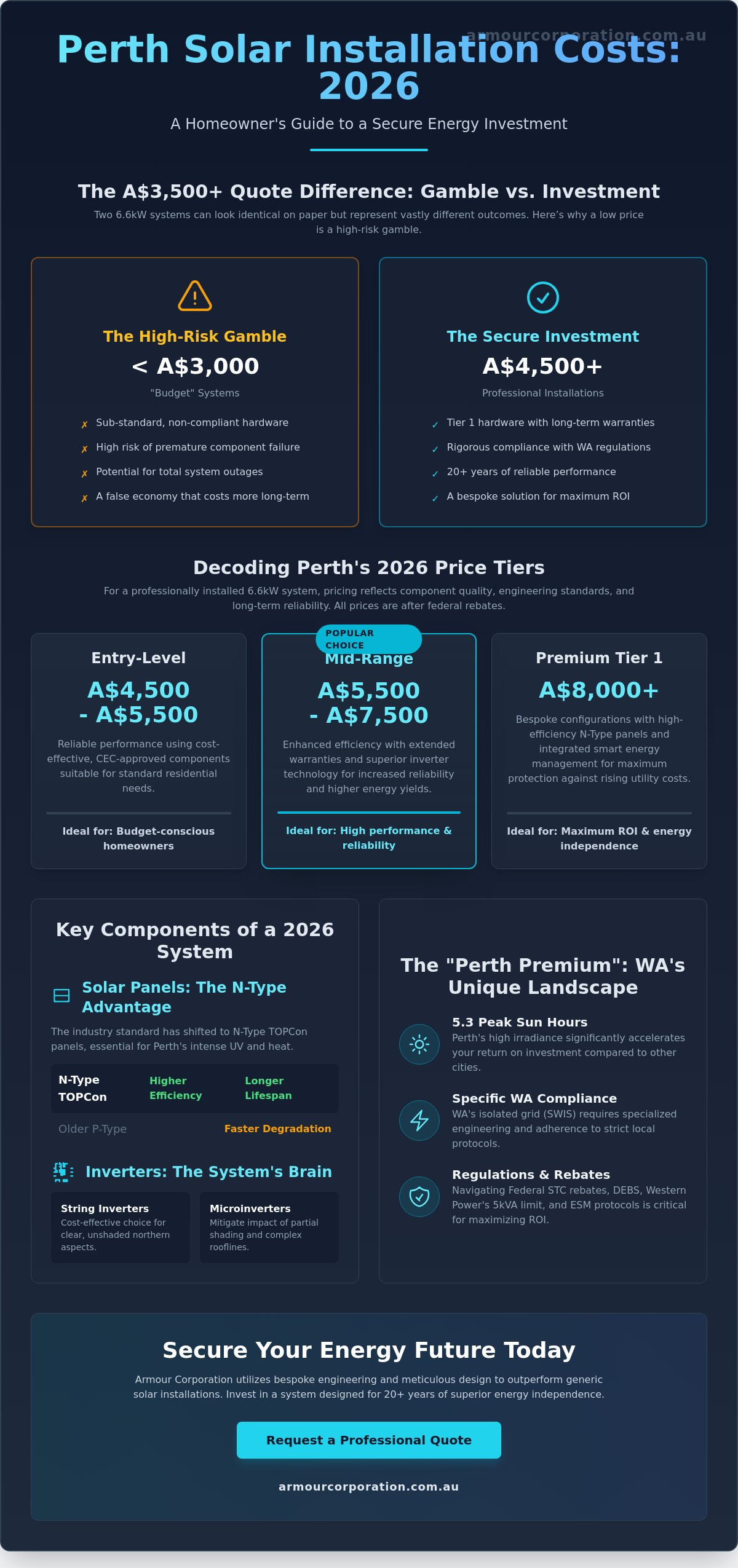
Armour Corporation observes that Perth remains the most competitive environment for renewable energy adoption in Australia. This market leadership is sustained by the city’s high installer density and exceptional levels of irradiance. When calculating how much to install solar panels Perth, homeowners must account for a landscape that prioritizes both high output and rigorous compliance. The current market average for a high-quality 6.6kW system typically ranges from A$4,500 to A$6,500 after the application of federal rebates. This price reflects the procurement of reliable components and professional installation standards necessary for Western Australia’s climate.
Armour identifies a significant risk in “budget” systems priced below A$3,000. These low-cost offerings frequently fail to meet the safety and durability standards mandated by Western Australian regulators. Opting for sub-standard hardware often results in premature component failure or total system outages, which compromises the security of your energy investment. The relationship between system size and component quality dictates the final invoice price. A strategic focus on Tier 1 hardware ensures long-term operational integrity and minimizes the need for future technical intervention.
The “Perth Premium”: Why WA Pricing Differs
Western Australia’s isolated energy grid requires specific electrical compliance protocols that differ from the eastern states. Local logistics and specialized WA-specific engineering standards influence the base cost of every installation. Perth’s geographical advantage is clear; the city averages 5.3 daily peak sun hours, which significantly accelerates the return on investment compared to other capital cities. Solar power in Australia has evolved rapidly, and Perth’s unique regulatory environment ensures that systems are built to withstand intense UV exposure. The Clean Energy Council (CEC) maintains strict oversight of Perth installations to ensure all systems contribute safely to the South West Interconnected System (SWIS).
Defining the 2026 Price Brackets
Armour categorizes the 2026 market into three distinct tiers to assist in professional decision-making. These brackets reflect the total cost including hardware, labor, and the necessary engineering certifications. Understanding how much to install solar panels Perth requires a clear view of these tiers:
- Entry-level Systems (A$4,500 – A$5,500): Reliable performance using cost-effective, CEC-approved components suitable for standard residential needs.
- Mid-range Systems (A$5,500 – A$7,500): Enhanced efficiency with extended warranties and superior inverter technology for increased reliability.
- Premium Tier 1 Systems (A$8,000+): Bespoke configurations featuring high-efficiency N-type panels and integrated smart energy management for maximum protection against rising utility costs.
Reputable Perth contractors utilize a comprehensive all-inclusive pricing model that integrates hardware procurement, expert labor, and mandatory engineering certification into a single transparent figure. This approach ensures there are no hidden costs during the deployment phase. Armour Corporation advocates for this level of transparency to maintain the integrity of the local solar industry and provide peace of mind to every client.
The Components of a Professional Solar Investment
Armour Corporation views a solar system as a critical infrastructure asset rather than a simple home appliance. When homeowners evaluate how much to install solar panels Perth wide, they must look beyond the initial quote to the technical specifications of the hardware. By 2026, the industry standard has shifted toward N-Type TOPCon (Tunnel Oxide Passivated Contact) technology. These panels offer superior efficiency and a lower degradation rate compared to older P-type models. Armour Corporation utilizes these components because they maintain performance levels even after 25 years of exposure to intense UV radiation.
The inverter serves as the operational intelligence of your system. For Perth rooftops, the choice between string inverters and microinverters depends on shading and roof complexity. String inverters remain a robust, cost-effective choice for clear northern aspects. However, microinverters provide granular control and mitigate the impact of partial shading from trees or neighboring structures. Armour Corporation integrates advanced CSIRO energy research findings into our selection process, ensuring every component meets the rigorous demands of the Australian grid.
- Panels: N-Type TOPCon cells provide a higher ceiling for energy harvest in high-heat environments.
- Inverters: High-frequency switching and robust heat-sink designs are essential for longevity.
- Racking: Structural integrity depends on anodized aluminum framing that resists the corrosive salt air of the WA coast.
- Monitoring: Software must provide real-time data to allow for precise management of self-consumption patterns.
Engineering for the WA Climate
Perth’s climate presents unique challenges that can compromise inferior hardware. Thermal mitigation is the primary concern; as temperatures rise above 25°C, solar panel efficiency typically drops. Armour Corporation selects gear with a low temperature coefficient to ensure maximum output during 40°C+ summer days. For properties in coastal suburbs such as Cottesloe or Scarborough, salt-mist corrosion resistance is a non-negotiable requirement. We utilize specialized mounting hardware and sealed electronics to prevent the rapid oxidation common in maritime environments. This meticulous approach to component selection is why the question of how much to install solar panels Perth residents face is often a matter of long-term value over the lowest upfront price.
The Armour Standard of Installation
Armour Corporation maintains a disciplined approach to the physical deployment of solar technology. Professional cable management is a core safety protocol; it prevents DC arc faults and eliminates long-term fire risks associated with exposed wiring. We reject “one-size-fits-all” layouts in favor of bespoke system designs that respect the architectural integrity of your property. Every installation follows a strict engineering framework to ensure wind load compliance during seasonal storms. For a deeper technical analysis of our protocols, refer to our Expert Solar Panel Installation Perth guide. Our commitment to precision ensures that your investment remains a secure and productive asset for decades. To secure your property with a system designed for maximum resilience, consider a consultation for bespoke energy protection.
Analysing ROI: System Sizes, Payback Periods, and Rebates
Determining how much to install solar panels Perth requires a precise evaluation of available subsidies and long-term yield. Armour views solar integration as a strategic asset for household risk mitigation. In 2026, the Federal Small-scale Technology Certificate (STC) scheme continues to lower upfront capital requirements. Although the STC value reduces annually as the program approaches its 2030 sunset, it remains a significant financial shield for Perth homeowners. This incentive acts as a point-of-sale discount, often reducing the total cost of a standard installation by thousands of dollars.
The Distributed Energy Buyback Scheme (DEBS) governs how you’re compensated for the energy you contribute back to the grid. In Western Australia, DEBS pricing prioritizes evening exports to encourage grid stability. Current 2026 rates provide a higher cent-per-kWh return for energy exported between 3 pm and 9 pm, while midday exports receive a lower rate. Armour clients who align their energy discharge with these peak windows maximize their financial integrity and shorten their path to total system ownership.
System Size Comparison: 6.6kW vs. 10kW
The 6.6kW system remains the operational standard for single-phase Western Power connections. This configuration typically generates between 26 and 29 kWh of clean energy daily within the Perth metro area. For households managing electric vehicle charging or larger families, a 10kW system offers superior energy security. While how much to install solar panels Perth increases with system size, the 10kW option provides the capacity needed for bespoke energy independence. A 10kW system in Perth can produce upwards of 44 kWh on a clear day, ensuring ample coverage for high-consumption appliances.
Financial Modelling and Payback Cycles
Achieving a 3-4 year payback period depends on a high “self-consumption” ratio. This refers to the percentage of solar energy used directly by your home rather than exported. By shifting heavy loads like pool pumps and dishwashers to the middle of the day, you avoid purchasing power at Synergy’s retail rates. The WA Residential Battery Rebate further enhances this model by subsidizing storage, allowing you to capture midday surplus for use during expensive evening peaks. This strategy provides a level of surveillance over your utility costs that traditional grid reliance cannot match.
Accurate forecasting requires a granular review of your Synergy bill. You must identify your usage during peak and off-peak periods to determine how a time-of-use (TOU) tariff will impact your ROI. Armour observes that many households reduce their annual electricity expenditure by over 70% following a professional installation. The opportunity cost of delaying your transition to solar is high; every billing cycle without a commissioned system represents a missed chance to mitigate rising energy prices. Armour ensures your investment is fortified against market volatility through meticulous planning and elite hardware selection.
Navigating Western Power Requirements and Local Regulations
Armour Corporation maintains that technical compliance is the foundation of any secure energy investment. Western Power enforces strict regulations across the South West Interconnected System (SWIS) to preserve grid stability. For most single-phase residential properties in Perth, a 5kVA inverter capacity limit applies. This rule dictates the maximum energy your system can output to the grid. While you can install more than 5kW of panels, the inverter must be capped to meet these specific utility standards.
The WA Government introduced Emergency Solar Management (ESM) requirements in February 2022. This mandate requires all new and upgraded systems to have a remote shut-off capability. During periods of extreme low demand, the Australian Energy Market Operator (AEMO) can signal your system to stop exporting power. This prevents grid over-voltage and potential blackouts. A professional installer manages this entire application process, ensuring your hardware is registered and compliant with these state-level security protocols.
Grid Connection and Export Management
Western Power often requires specific export profiles based on local network density. In certain Perth suburbs, you might face a “zero export” or “limited export” profile. This means your system cannot send excess energy back to the grid for a feed-in tariff. To mitigate this loss, a smart meter is essential. It provides the surveillance needed to monitor your energy flow in real-time. When considering how much to install solar panels Perth, you must account for these technical configurations. Integrating battery storage solutions is the most effective way to capture surplus energy that the grid cannot accept.
Avoiding the “Solar Cowboy” Trap
When analyzing how much to install solar panels Perth, the cheapest quote often masks significant operational risks. Low-cost “solar cowboys” frequently utilize sub-contracted labor and hardware with no local support infrastructure. Armour Corporation identifies several red flags in these offerings:
- Generic hardware that lacks long-term performance data in WA’s harsh climate.
- A lack of a physical Perth office, making warranty claims nearly impossible.
- Quotes that omit the cost of a necessary switchboard upgrade.
Current Australian standards require that any major electrical addition, such as solar, triggers a compliance check of your existing RCDs and smoke alarms. If your switchboard is outdated, it must be modernized to meet AS/NZS 3000 safety standards. Choosing an elite provider ensures these safety measures are integrated into the initial project scope, protecting both your property and your family.
Securing Your Energy Future with Armour Corporation
Armour Corporation views residential energy as a vital pillar of household security. We apply rigorous electrical engineering principles to every installation, ensuring your transition to renewable power is both safe and permanent. While homeowners frequently investigate how much to install solar panels Perth families often ignore the long-term costs of system degradation found in mass-market kit systems. Our bespoke designs focus on maximum yield and operational longevity. We don’t settle for generic configurations. We analyze your specific site conditions to create an energy shield that performs reliably under the harsh Western Australian sun.
Our commitment to the Perth community is rooted in our status as a family-owned and operated business. We don’t answer to distant shareholders; we’re accountable to the neighbors we serve every day. This local focus ensures that our engineering decisions are tailored to the specific grid requirements and environmental challenges of the Perth metropolitan area. When you choose Armour, you’re investing in a partnership dedicated to your long-term energy independence.
Professionalism and Integrity
Armour Corporation enforces a rigorous no-shortcut policy regarding roof mounting and electrical terminations. Every connection represents a potential point of failure. Our technicians treat each termination with meticulous care to prevent future maintenance issues. We integrate your new solar infrastructure with our comprehensive electrical services to guarantee that your home’s entire power network remains resilient. Our Master Electrician certification is a commitment to professional integrity and technical excellence. It ensures that your system meets the highest safety standards in the solar sector.
The Path to Energy Sovereignty
Energy sovereignty is the ultimate objective for the modern Perth homeowner. This goal is best achieved by synchronizing your power generation with efficient consumption. Integrating your solar array with a specialized air conditioner service ensures your climate control doesn’t drain your savings during peak summer months. When calculating how much to install solar panels Perth residents should prioritize the total cost of ownership over 25 years. A system engineered by Armour Corporation mitigates future repair risks and maximizes your return on investment through superior component selection.
Your path to energy independence begins with an engineered assessment. To facilitate a precise quote, please have your most recent 12 months of energy data and switchboard access ready for our team. We provide a comprehensive site audit followed by a bespoke proposal that outlines your projected yield and ROI. Contact Armour Corporation for a professional solar assessment and secure your home’s energy future with an elite tier of protection.
Secure Your Energy Independence in 2026
Investing in renewable infrastructure requires a strategic understanding of both initial capital and long-term system integrity. By 2026, the Western Australian energy market has shifted toward high-efficiency components that demand strict compliance with Western Power technical requirements. Determining how much to install solar panels Perth involves weighing these regulatory standards against the bespoke engineering required for our local climate. Armour Corporation delivers this precision through a disciplined approach to installation and risk mitigation.
Our status as a WA family-owned and operated business ensures that your investment stays within the community. Armour Corporation utilizes Master Electricians Certified teams to guarantee every project meets elite safety protocols. We focus on maximizing your return on investment by optimizing system architecture for Perth’s unique environmental stressors. This commitment to operational excellence provides the peace of mind that your energy future is protected by industry-leading expertise.
Secure your engineered solar solution with Armour Corporation today.
Taking control of your power costs is a decisive step toward lasting financial security and environmental resilience.
Frequently Asked Questions
How much do solar panels cost in Perth for a standard 4-bedroom home?
Armour Corporation observes that a standard 6.6kW solar system for a four-bedroom Perth residence typically ranges between A$5,500 and A$9,500. This investment covers high-efficiency modules and professional installation by accredited technicians. Total costs vary based on component selection and roof complexity. Armour ensures every installation meets rigorous safety standards to protect your long-term energy security and operational reliability.
Is the federal solar rebate still available in Perth in 2026?
The federal Small-scale Renewable Energy Scheme remains active in 2026, though the incentive value continues its scheduled annual reduction. This rebate provides an upfront discount on the how much to install solar panels Perth homeowners must pay. Armour Corporation monitors these regulatory shifts to ensure clients maximize available financial offsets before the program officially terminates in 2030. Precise rebate values depend on the system’s total kilowatt capacity.
What is the best angle and orientation for solar panels in Perth?
Solar panels in Perth achieve maximum annual generation when oriented North at a tilt angle of 30 to 32 degrees. West-facing arrays offer strategic advantages by producing more power during peak afternoon periods when household demand typically surges. Armour Corporation designers calculate bespoke tilt and orientation metrics to optimize the energy harvest for your specific property layout. This precision ensures your system maintains peak performance throughout the year.
Do I need to upgrade my switchboard to install solar panels?
You’ll require a switchboard upgrade if your current electrical infrastructure lacks the capacity or safety components mandated by AS/NZS 3000 standards. Older Perth homes often feature ceramic fuses that must be replaced with modern circuit breakers and RCDs to maintain system integrity. Armour technicians conduct thorough site audits to identify these requirements. We ensure your installation remains compliant and secure against electrical faults or fire risks.
How long does it take for solar panels to pay for themselves in WA?
Solar systems in Western Australia typically achieve a full return on investment within 3 to 5 years. High solar irradiance in the Perth metropolitan area accelerates this timeline, especially when households shift heavy energy usage to daylight hours. Armour Corporation focuses on system longevity. We ensure your equipment continues providing financial benefits and peace of mind long after the initial payback period concludes.
What happens to my solar panels if there is a Western Power grid outage?
Standard grid-connected solar systems automatically deactivate during a Western Power grid outage to prevent dangerous back-feeding. This safety protocol protects utility workers who are performing repairs on the network. Armour Corporation provides advanced battery storage solutions with backup power capabilities for clients who require uninterrupted energy. These systems isolate your home from the grid, providing a bespoke shield against local power failures.
Can I add a battery to my Perth solar system later?
You can integrate a battery storage unit into your existing Perth solar system at any time through AC coupling or a hybrid inverter swap. Planning for this expansion during the initial installation phase often reduces future labor costs and simplifies the integration process. Armour Corporation assists clients in future-proofing their energy infrastructure. We ensure seamless transitions to full energy independence while maintaining the highest standards of surveillance and control.
What is the difference between Tier 1 and budget solar panels?
Tier 1 solar panels represent the top 2 percent of manufacturers characterized by financial stability and advanced robotic production. These modules offer superior 25-year warranties and higher performance reliability compared to budget alternatives. Armour Corporation prioritizes Tier 1 hardware to mitigate technical risks. Choosing premium components ensures the long-term operational excellence of your energy assets and guards against the common failures associated with low-cost equipment.
