
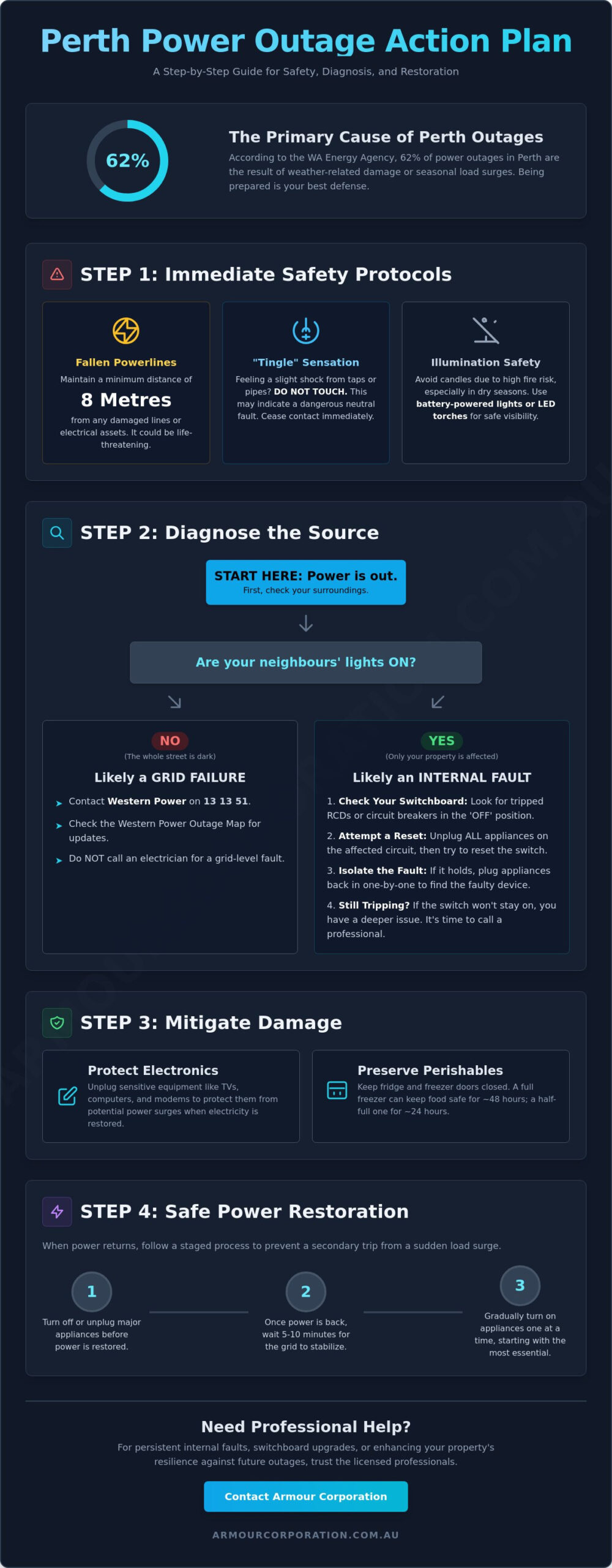
According to the Western Australia Energy Agency, 62% of power outages in Perth result from weather-related damage or seasonal load surges. When the lights fail, the sudden silence often signals a period of heightened risk for both residential safety and commercial continuity. You aren’t merely facing an inconvenience; you’re managing a situation where improper action can lead to appliance damage or significant operational downtime. Understanding exactly what to do when power goes out Perth residents and business owners can ensure that a localized fault or grid-wide event is handled with professional precision.
This article provides a comprehensive protocol to help you diagnose the fault source, confirm immediate safety, and protect your high-value equipment from surge damage. We’ll outline the critical steps for identifying whether to contact Western Power or investigate your own switchboard. You’ll gain a clear understanding of food safety timelines and the diagnostic techniques required to maintain electrical resilience. By following this structured response, you can move from uncertainty to a state of absolute operational mastery and security.
Key Takeaways
- Establish an immediate safety perimeter of at least eight metres around any damaged electrical infrastructure or fallen powerlines to mitigate life-threatening risks.
- Learn exactly what to do when power goes out Perth residents need to know to distinguish between a Western Power grid failure and a localized fault in your own switchboard.
- Safeguard sensitive electronic equipment and preserve perishable goods by following professional surge protection and cold-chain management protocols.
- Implement a structured, staged restoration process to reintroduce electrical load safely and prevent secondary system trips once power is restored.
- Enhance future property resilience by evaluating switchboard modernization and battery storage solutions for sustained operational mastery.
Immediate Response: Safety Protocols for Perth Power Outages
Armour Corporation prioritizes the immediate security of your electrical infrastructure during any supply disruption. The moment power fails, your primary objective is the establishment of a secure environment. Immediate triage prevents physical harm and mitigates the risk of catastrophic hardware failure. While a power outage overview explains the systemic causes of grid instability, your focus must remain on the immediate physical perimeter. The first 60 seconds of any disruption are the most critical. This is when you must isolate sensitive electronics to prevent damage from potential voltage spikes during the initial fault.
Identifying Life-Threatening Hazards
Perth’s infrastructure is susceptible to weather-related damage, often resulting in downed lines. You must maintain a minimum distance of eight metres from any fallen powerlines or damaged electrical assets. This perimeter is non-negotiable. Contact Western Power immediately if you observe compromised infrastructure. You must also remain vigilant regarding the “tingle” factor. If you experience a slight electrical sensation when touching metallic taps or pipes, this indicates a potentially lethal neutral fault. This situation requires you to cease all contact with plumbing fixtures and seek professional intervention. During Perth’s dry summer months, avoid using candles for illumination. The fire risk is unacceptably high. Use LED torches or battery-powered lanterns to maintain visibility without compromising fire safety.
The Essential Perth Outage Contact List
Understanding the hierarchy of response is vital for rapid restoration. Western Power is the network distributor responsible for the lines and the grid. You should contact their 24/7 emergency line on 13 13 51 for all network faults. Synergy, conversely, is your retailer and manages billing and accounts; they don’t handle physical repairs. When determining what to do when power goes out Perth residents must first identify the fault’s location. If the outage is limited to your property and the street lights remain operational, the issue likely resides within your internal system. In such instances, you must engage a licensed emergency electrician to conduct faultfinding. For widespread outages, utilize the Western Power Outage Map for real-time suburb updates and estimated restoration times. Only call 000 in the event of an immediate threat to life or a fire.
Diagnosing the Source: Grid Failure vs. Internal Faults
Effective diagnosis begins with a systematic visual audit of your immediate surroundings. Before you engage with your electrical infrastructure, observe the status of street lighting and neighboring properties. If the entire street is dark, the issue likely originates within the South West Interconnected System (SWIS). However, if your neighbors have power, the fault is almost certainly isolated to your premises. Understanding what to do when power goes out Perth residents often find themselves at a crossroads between reporting a network fault or initiating internal troubleshooting. A localized blackout usually indicates a tripped safety switch or a blown service fuse, requiring a different tactical response than a grid-wide failure.
The Switchboard Audit
Your switchboard serves as the primary diagnostic tool for your property’s electrical health. Modern circuit breakers and Residual Current Devices (RCDs) are designed to trip to the “Off” position when they detect an abnormality, such as a short circuit or earth leakage. If the main switch remains in the “On” position but you lack power, the fault may lie with the Western Power service fuse. If an RCD has tripped, you should attempt a systematic process of elimination. Unplug all appliances on that circuit and reset the switch. If the system holds, reintroduce devices one by one to identify the faulty unit. Persistent tripping despite these efforts suggests a deeper infrastructure issue. A professional switchboard upgrade is often necessary for older Perth homes to ensure compliance with modern safety standards and load demands.
Grid-Level Indicators in Perth
Western Power manages high-stakes load balancing across the SWIS, especially during peak summer periods. You may encounter a “brownout,” characterized by dimming lights or erratic appliance behavior, which signifies a significant voltage drop. This is distinct from a total blackout and poses a high risk to motor-driven equipment like air conditioners. During these events, maintaining food and water safety is paramount as refrigeration systems may fail to maintain critical temperatures. For commercial and industrial sites, a loss of a single phase in a three-phase system can cause specific machinery to fail while other parts of the facility remain powered. When determining what to do when power goes out Perth business operators must immediately isolate three-phase motors to prevent burnout. If your diagnosis reveals an internal system failure, Armour Corporation provides the expertise required for faultfinding and repair of electrical installations to restore your operational stability.
Mitigating Damage: Protecting Appliances and Perishables
A power failure introduces a secondary risk profile beyond the loss of illumination: the potential for catastrophic hardware damage and significant inventory loss. Identifying what to do when power goes out Perth residents can effectively safeguard their high-value assets by adhering to a strict isolation protocol. You must recognize that the restoration of supply is often accompanied by transient voltage surges. These spikes can overwhelm the delicate printed circuit boards (PCBs) found in modern electronics. Armour Corporation recommends the immediate physical disconnection of sensitive hardware, including computer systems, home cinema equipment, and specialized medical devices, to ensure their long-term operational integrity.
Your property’s security and energy generation also require immediate attention. Most residential solar PV systems are engineered with anti-islanding protection, meaning they will automatically cease generation and export during a grid failure to protect utility workers. Unless your system is equipped with specific battery storage and backup capabilities, your solar panels will not provide power during an outage. Simultaneously, you should verify the location of manual overrides for electric gates and garage doors. Maintaining site accessibility and security is paramount, especially if the outage persists into the evening hours. Locate the manual release mechanism, typically a cord or key-operated clutch, to ensure you aren’t trapped within your perimeter.
Electronics and Appliance Security
The “Surge” is a documented phenomenon where the re-engagement of the grid delivers a momentary peak in voltage. This event is a primary cause of appliance failure following a blackout. To manage this risk, isolate all non-essential equipment but leave a single lamp in the “On” position to serve as a visual indicator of restoration. Specific care must be taken with air conditioning systems during these cycles. Rapidly toggling power can stress compressors and control modules. Ensure these systems are switched off at the wall or isolation switch until the grid supply has stabilized for several minutes.
Food Safety and Refrigeration
Maintaining the cold chain is a critical logistical challenge during an outage. A closed refrigerator will maintain a safe internal temperature for approximately four hours. After this threshold, perishable goods enter the “danger zone” where bacterial growth accelerates. The most frequent error made during a Perth blackout is the repetitive opening of freezer doors to inspect contents. A full freezer can maintain its thermal integrity for up to 48 hours if the seal remains unbroken. For commercial operators, protecting high-value stock requires a documented protocol for inventory transfer or the activation of onsite backup generation to prevent total stock loss.
Restoration Protocol: Safe Re-engagement of Power
Armour Corporation mandates a disciplined approach to the re-energisation of your property. The return of grid supply isn’t an invitation to immediately restore full operational load. Instead, it represents a high-stakes transition where technical precision prevents secondary system failures. A sudden, simultaneous demand from high-draw appliances can trigger secondary trips and place undue stress on your internal infrastructure. When determining what to do when power goes out Perth residents should treat the restoration phase with the same vigilance as the initial failure. Controlled re-engagement ensures that your system stabilizes before reaching peak capacity.
The 5-Step Re-energisation Sequence
Successful restoration begins with verification. Observe your designated signal lamp or local street lighting to confirm that the South West Interconnected System has stabilized. You must ensure all high-draw appliances, such as ducted air conditioning or electric ovens, remain isolated before engaging the main switch. Once the main supply is active, incrementally re-engage individual circuit breakers. Start with lighting and low-voltage power circuits before introducing heavier loads. During the first hour of operation, you must monitor the switchboard for heat or buzzing. Any unusual auditory or thermal signatures indicate a potential fault that requires immediate professional attention.
Post-Outage Equipment Checks
Mechanical safety devices can occasionally seize or fail following a significant power cycle. You should perform a manual test of all Residual Current Devices (RCDs) by depressing the “Test” button; the switch must trip instantly to confirm its protective capability. Simultaneously, verify that your solar PV inverter has successfully cleared any anti-islanding fault codes and has synchronized with the grid. Modern systems installed after May 1, 2026, may require a moment to complete remote reconnection protocols mandated by new regulations. Finally, inspect your hard-wired smoke alarms. A persistent chirping sound often indicates that the battery backup was depleted during the outage and requires replacement to maintain your safety perimeter.
Restoration also involves the recalibration of your property’s automation. You must synchronize digital clocks, security timers, and irrigation schedules to prevent operational overlaps. If you observe flickering lights, acrid smells, or persistent circuit trips following a major surge event, the integrity of your installation may be compromised. Armour Corporation provides elite Residential Electrical Services to conduct comprehensive faultfinding and restore your property to a state of absolute stability. Professional verification is the only way to ensure that a temporary outage hasn’t caused permanent, hidden damage to your wiring.
Future Resilience: Engineering Your Property Against Outages
Armour Corporation advocates for a transition from reactive crisis management to proactive infrastructure fortification. While previous sections detailed what to do when power goes out Perth residents must recognize that true security lies in engineering for independence. The modern Perth energy landscape is increasingly volatile. This shift necessitates a move toward systems that maintain operational continuity without reliance on the external grid. Investing in robust infrastructure today ensures that your property remains functional when the South West Interconnected System (SWIS) fails. We position our clients at the forefront of energy technology to ensure their homes and businesses remain impenetrable to grid instability.
Solar and Battery Integration
A common misconception is that solar panels alone provide power during a blackout. Standard grid-tied systems are designed to deactivate for safety. To achieve genuine resilience, you must integrate battery storage solutions equipped with an Emergency Power Supply (EPS) function. This technology allows your property to island itself from the grid, providing a seamless transition to stored energy. In the 2026 market, the ROI for energy storage isn’t merely financial; it’s measured in the psychological reassurance of uninterrupted power. We differentiate between basic storage and off-grid capable systems to ensure your critical loads, such as medical equipment or security networks, remain active during prolonged outages.
Professional Infrastructure Upgrades
The foundation of any resilient property is a modernized switchboard. Older installations often lack the capacity to manage the sophisticated surge protection required by modern electronics. Armour Corporation recommends the installation of whole-house surge protection as a mandatory shield against grid-level voltage spikes. For aging properties, master electrician inspections are essential to identify latent vulnerabilities before they manifest as failures during a storm or load surge. These audits provide a detailed roadmap for upgrading your electrical architecture to meet current WA Electrical Requirements (WAER) standards.
Commercial and industrial entities face higher stakes. Fluctuations in power can corrupt data and damage sensitive automation components. We specialize in protecting SCADA and PLC systems through the implementation of industrial-grade Uninterruptible Power Supplies (UPS) and advanced automation controls. These systems provide the necessary buffer to allow for controlled shutdowns or a switch to backup generation. By conducting a professional audit, Armour Corporation ensures that no detail is overlooked in the defense of your operational mastery. We don’t just restore power; we engineer the systems that prevent its loss from becoming a business-critical event.
Securing Your Electrical Infrastructure
Managing a power disruption requires more than immediate reaction; it demands a structured protocol that prioritizes safety and infrastructure integrity. You now possess the professional knowledge to establish a secure perimeter around hazards and systematically diagnose the source of any failure. By implementing a staged restoration and considering advanced upgrades like battery storage, you transform a potential crisis into a manageable operational event. Understanding exactly what to do when power goes out Perth residents can ensure their assets remain protected against the inherent instability of the grid.
Armour Corporation stands as a disciplined guardian for your electrical systems. As a family-owned WA business, we utilize qualified Master Electricians to deliver unwavering reliability and operational mastery. Our 24/7 emergency response capability ensures that expert guidance is always accessible when the stakes are highest. Secure your property’s power resilience with Armour Corporation’s expert electrical services. We remain committed to your safety and the continued stability of your electrical environment.
Frequently Asked Questions
Is it safe to use a portable generator during a power outage in Perth?
Portable generators are safe only when operated in well-ventilated outdoor areas and connected via a professionally installed changeover switch. You must never connect a generator directly to your home’s wiring through a standard power outlet, as this creates a lethal backfeeding risk for utility workers. Armour Corporation recommends utilizing a licensed professional to integrate a permanent transfer switch for seamless emergency transitions and operational security.
How do I report a power outage to Western Power?
You should report any network-level failure by contacting the Western Power 24/7 emergency line on 13 13 51. For non-urgent status updates, the Western Power real-time outage map provides suburb-specific data and estimated restoration times. Providing accurate site information helps the distributor prioritize repairs during widespread weather events or seasonal load surges across the South West Interconnected System.
Why did my power go out but my neighbours’ lights are still on?
If your property lacks power while adjacent buildings remain illuminated, the fault is likely isolated to your internal system or your specific service fuse. This often indicates a tripped Residual Current Device (RCD) or a blown main fuse caused by a localized appliance failure. Understanding what to do when power goes out Perth residents face can help you determine if the issue is a single-phase drop or an internal circuit fault.
What should I do if I see a fallen power line in Perth?
You must maintain a minimum safety perimeter of eight metres from any fallen powerlines or damaged electrical infrastructure. Report the hazard immediately to Western Power on 13 13 51 or call 000 if there is an immediate threat to life. Treat all downed lines as energized and lethal, even if they appear stationary or do not exhibit visible sparking, arcing, or smoke.
Can a power outage damage my solar panels or inverter?
Standard solar PV systems are designed to automatically disconnect during a blackout via anti-islanding protection, which prevents damage to the inverter. However, the transient voltage surges that often accompany power restoration can compromise sensitive internal components and printed circuit boards. Armour Corporation advises a professional inspection if your inverter displays persistent error codes or fails to synchronize with the grid following a major disruption.
How long will food stay safe in the fridge during a blackout?
Refrigerated food remains safe for approximately four hours provided the door remains closed to maintain thermal integrity. A full freezer can preserve its contents for up to 48 hours, while a half-full unit typically lasts 24 hours. Adhering to the “4-hour/2-hour rule” is essential; you must dispose of any perishable goods that have been held between 5°C and 60°C for four hours or longer.
When should I call an emergency electrician vs. Western Power?
You should contact Western Power for outages affecting your entire street or for visible damage to network poles and wires. If the outage is limited to your property and the street lighting is functional, you must engage a licensed emergency electrician for faultfinding. Armour Corporation provides expert diagnostics to identify internal circuit failures that the network distributor is not authorized to repair or investigate.
What is an RCD and why does it trip during a storm?
A Residual Current Device (RCD) is a safety switch designed to disconnect power instantly when it detects a leakage to earth, preventing lethal electric shocks. During storms, moisture ingress into outdoor fittings or lightning-induced surges can trigger these devices. Frequent tripping indicates that your system requires professional testing to ensure the RCD hasn’t seized or become compromised by moisture-related faults within your installation.
