
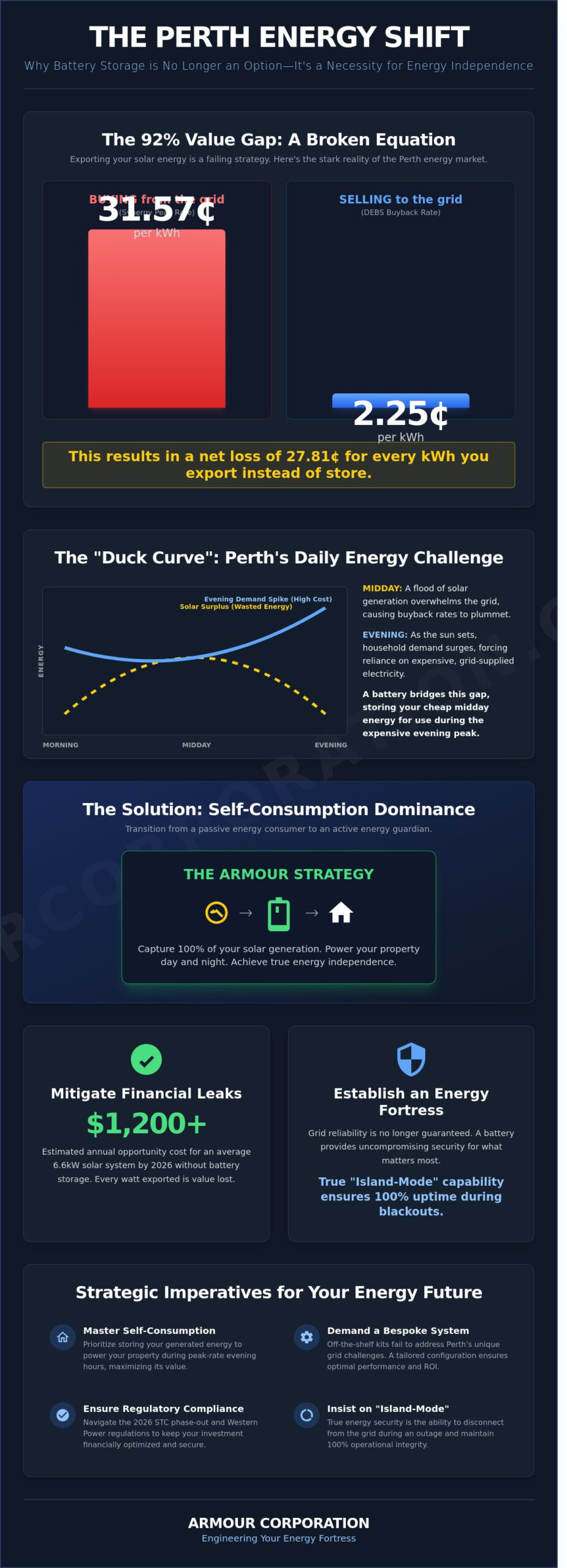
As of early 2024, Synergy’s peak electricity rates reached 31.57 cents per kilowatt-hour, while the Distributed Energy Buyback Scheme (DEBS) offers as little as 2.25 cents for solar exports during peak generation hours. This 92% value gap confirms that relying on the grid is no longer a viable strategy for fiscal mitigation. Armour Corporation recognizes that without sophisticated battery storage solutions, your solar investment remains vulnerable to external market fluctuations and grid instability. You’ve likely noticed that feeding the grid provides diminishing returns while your monthly bills continue to escalate.
This guide provides the strategic framework required to secure your energy future and achieve total independence by 2026. We’ll detail how to master the technical landscape of Perth energy storage to protect your property against blackouts and rising costs. Armour Corporation outlines the transition from passive consumption to active energy guardianship, focusing on bespoke hardware configurations and precise ROI projections that ensure your operational integrity remains uncompromised. We’ll examine high-performance hardware and the integration of uninterruptible power supplies to maintain absolute security during grid failures.
Key Takeaways
- Master the transition from daytime solar generation to constant energy availability to mitigate the impact of Perth’s evolving grid challenges.
- Identify the precise technical configurations required to maintain operational integrity through a deep understanding of AC and DC coupled systems.
- Navigate the 2026 STC phase-out and Western Power regulations to ensure your investment remains compliant and financially optimized.
- Discover how bespoke battery storage solutions outperform off-the-shelf kits by providing a tailored shield against rising energy costs.
- Evaluate critical performance metrics, including capacity and Depth of Discharge, to guarantee your infrastructure meets high-tier security standards.
The Strategic Necessity of Battery Storage Solutions in Perth
Armour Corporation views energy as the primary foundation of operational integrity. In the Western Australian energy market, the implementation of battery storage solutions has transitioned from an optional upgrade to a defensive requirement. As of 2025, Perth’s South West Interconnected System (SWIS) faces a critical technical challenge known as the “Duck Curve.” During midday hours, the sheer volume of rooftop solar generation creates a surplus that the grid cannot always absorb, leading to potential voltage instability. Armour Corporation identifies this surplus as a wasted asset unless it’s captured and controlled. A battery acts as the essential bridge, allowing you to harvest energy at 12:00 PM and deploy it during the high-demand period of 6:00 PM.
The Perth energy landscape is unique due to its isolation and high solar penetration. When the sun sets, the sudden drop in solar production combined with a spike in household demand forces the grid to ramp up traditional generation rapidly. This volatility creates a strategic vulnerability for any property owner. By integrating battery storage solutions, you effectively remove your reliance on this fluctuating system. You transform your property into a self-sustaining unit that maintains its own power equilibrium, ensuring that your energy security remains uncompromised by external grid pressures.
The Death of High Feed-in Tariffs
The era of generating profit through solar exports is over. Under the Distributed Energy Buyback Scheme (DEBS), Synergy provides a minimal return for the electricity you send back to the grid. The financial disparity is stark and demands a shift in strategy:
- Export Rate: Synergy currently offers as little as 2.25c/kWh for electricity exported before 3:00 PM.
- Purchase Rate: The standard A1 home tariff for purchasing electricity is approximately 30.06c/kWh.
- Net Loss: You lose 27.81 cents for every kilowatt-hour you export rather than store.
- Annual Opportunity Cost: For an average 6.6kW system, failing to store energy can result in over $1,200 of lost value each year by 2026.
Armour Corporation prioritizes the mitigation of these financial leaks. Exporting power at a 92% discount compared to the purchase price is a failed strategy. We focus on self-consumption dominance, where every watt generated by your panels is retained for your own use, shielding you from Synergy peak tariff spikes that typically occur between 3:00 PM and 9:00 PM.
Energy Security as a Corporate and Residential Asset
Grid reliability is no longer a guarantee during extreme weather events or periods of peak regional load. Armour Corporation approaches energy through the lens of protection and risk management. It’s vital to understand how modern battery systems operate to appreciate the security they provide. Standard grid-tie solar systems are designed to shut down during a power outage to prevent back-feeding the grid. This leaves your property dark despite having solar panels on the roof.
We advocate for bespoke hybrid systems equipped with true “island-mode” capabilities. This technology allows your battery to decouple from the grid instantly during a failure, creating a localized power shield. This ensures that critical infrastructure, such as surveillance systems, medical equipment, and communications, maintains 100% uptime. Security is a continuous state that requires constant power; a battery provides the endurance necessary to maintain that state. Armour Corporation ensures that your property remains a functional fortress, regardless of the grid’s operational status.
Engineering the Shield: How Modern Battery Systems Operate
Armour views energy infrastructure as a critical line of defense for the modern Perth household. Modern battery storage solutions function as sophisticated power reserves, utilizing complex internal architectures to ensure total reliability. At the core of these high-tier systems lies the Battery Management System (BMS). This digital sentry provides constant surveillance of every individual cell, mitigating risks of overheating or voltage fluctuations. It maintains the integrity of the entire stack; it ensures the system operates within its 100% safe operational envelope even during Perth’s 44-degree summer peaks. Armour prioritizes this level of technical oversight to guarantee that your energy shield remains impenetrable.
AC vs. DC Coupling: Which Architecture Fits Your Property?
DC coupling represents the most efficient path for new 2026 installations. It channels solar energy directly into the battery with minimal conversion, achieving round-trip efficiencies as high as 97.5%. Conversely, AC coupling offers a bespoke solution for property owners retrofitting battery storage solutions to existing 5kW or 10kW solar arrays. While AC systems incur a 1.5% to 3% conversion loss due to multiple inversion steps, they provide the tactical flexibility required to integrate with older inverter technology without overhauling the entire solar system.
- DC Coupling: Best for new builds; minimizes energy loss during the charging phase.
- AC Coupling: Ideal for retrofitting; allows for independent battery and solar inverter placement.
- Efficiency Trade-offs: DC systems generally save 200kWh to 400kWh of energy annually through reduced heat loss.
The Chemistry of Reliability: LFP vs. NMC
Armour recommends Lithium Iron Phosphate (LFP) for the harsh Western Australian climate due to its superior thermal stability and safety profile. LFP cells can withstand internal temperatures up to 270 degrees Celsius before risking thermal runaway. In contrast, Nickel Manganese Cobalt (NMC) cells reach this threshold at approximately 210 degrees. NMC remains a viable choice for sites with limited spatial footprints because its energy density is roughly 30% higher than LFP alternatives. Cycle life is the primary metric for long-term battery value, representing the total number of full charge and discharge sequences a system completes before its capacity drops below 80% of its original rating.
Preparing for the 2026 energy market requires infrastructure capable of Vehicle-to-Grid (V2G) and Virtual Power Plant (VPP) communication. These protocols allow your asset to interact with the Western Australian grid, providing stabilization services during peak demand periods. This strategic integration transforms a passive storage unit into an active revenue generator. You can secure your energy future by investing in bespoke energy protection that meets these evolving technical standards. Armour ensures every installation is ready for the decentralized grid of tomorrow, providing peace of mind through engineering excellence.
Comparative Analysis: Selecting Your Battery Infrastructure
Armour Corporation views battery infrastructure as the cornerstone of energy resilience. Selecting the correct hardware requires a technical understanding of capacity versus power output. Capacity, measured in kilowatt-hours (kWh), dictates the total energy volume available. Power output, measured in kilowatts (kW), determines the volume of electricity the system can discharge at any single moment. A 10kWh battery with a 2kW output won’t support a 4kW air conditioning unit; the system will simply fail to meet the demand. Armour technicians prioritize high-output systems to ensure your battery storage solutions remain functional during peak evening loads.
Depth of Discharge (DoD) and round-trip efficiency serve as the primary metrics for usable energy. Most modern lithium-ion systems offer a 90% to 100% DoD. If a battery has a 10kWh capacity but only a 90% DoD, you only have access to 9kWh. Efficiency losses also occur during the conversion from DC to AC power. High-tier systems maintain a 92% round-trip efficiency, while lower-quality alternatives often drop to 83%. This 9% difference represents hundreds of dollars in lost energy over the life of the system.
Warranty analysis must extend beyond the standard 10-year marketing headline. Armour Corporation audits the “throughput” clauses within these contracts. Many manufacturers limit their liability to a specific amount of energy discharged, such as 30MWh. A household that cycles their battery twice daily may reach this limit in 7.2 years, effectively voiding the 10-year protection early. We ensure your contract reflects your actual usage patterns to maintain long-term security.
Sizing Your System for Maximum ROI
Armour Corporation utilizes precise load profiling to prevent inefficient over-sizing. A typical 4-person Perth residence consumes 19 to 23kWh daily. For these homes, a 10kWh to 13.5kWh system offers the fastest payback, typically reaching break-even within 6.5 years. In contrast, a commercial warehouse in Balcatta requires bespoke 30kWh+ configurations. These larger systems focus on peak shaving, reducing demand charges that often constitute 35% of a commercial energy bill.
The Perth Heat Factor: Thermal Management Systems
Perth’s climate presents a tactical challenge for hardware longevity. Ambient temperatures in northern suburbs frequently exceed 40°C, which can accelerate chemical degradation by 15% annually without proper mitigation. Armour recommends active liquid cooling for any battery storage solutions installed in high-heat zones. Data from 2024 indicates that batteries installed in shaded, internal garages retain 12% more capacity after five years than those mounted on western-facing external walls. System integrity depends entirely on strategic placement and industrial-grade thermal management.
Navigating the Western Australian Regulatory and Financial Landscape
The Western Australian energy landscape demands a disciplined approach to technical compliance. Armour Corporation prioritizes the integrity of every installation by strictly adhering to the Clean Energy Council (CEC) approved product list. This is not merely a recommendation; it’s a fundamental requirement for insurance eligibility in 2026. Most major Australian insurers now verify that battery storage solutions meet these rigorous safety standards before honoring claims related to electrical incidents. Using non-approved hardware risks total policy voidance and compromises the safety of your property.
Western Power and Synergy: The Compliance Checklist
Western Power maintains strict control over the South West Interconnected System (SWIS) through inverter capacity limits. For most residential applications, a 5kVA limit applies to single-phase connections. This constraint requires strategic configuration to ensure your battery discharge rates don’t trigger grid protection relays or exceed export limits. The application process involves detailed technical submissions to both Synergy and Western Power. Armour Corporation utilizes master electricians to oversee these complex deployments. These professionals provide the technical surveillance necessary to ensure every connection point remains secure and compliant with the updated AS/NZS 4777.2 standards.
Financial Incentives and Payback Projections
Financial planning for 2026 must account for the Small-scale Technology Certificate (STC) phase-out schedule. The federal government reduces the subsidy multiplier every January 1st. By 2026, the financial offset for a standard 10kWh system will be approximately 25% lower than it was at the start of the decade. To counter this reduction, owners must leverage the Distributed Energy Buyback Scheme (DEBS). Exporting power between 3 pm and 9 pm yields a significantly higher return than midday generation. Current performance data suggests that high-tier battery storage solutions reach full payback within 7.2 to 8.4 years when managed through smart automation.
- STC Reduction: The deeming period drops again on January 1, 2026, increasing upfront costs.
- DEBS Optimization: Program your system to discharge during peak evening windows to maximize credit value.
- VPP Revenue: Virtual Power Plants allow you to trade stored energy during grid emergencies for passive credits.
- Financing: Low-interest green loans allow for immediate installation without depleting liquid capital reserves.
Virtual Power Plants (VPPs) represent a tactical shift in energy management for Perth residents. Participants receive financial credits for allowing the grid to draw from their reserves during peak load events. This creates a secondary revenue stream that accelerates your return on investment while supporting grid stability. It’s a proactive method of risk mitigation that benefits both the individual owner and the wider community. Armour Corporation ensures your system is VPP-ready from the day of commissioning.
Implementing Your Armour-Grade Energy Solution
Armour Corporation treats every energy project as a critical infrastructure deployment. We reject the generic approach of mass-market solar kits that often fail to account for Perth’s specific thermal loads. These retail packages frequently lack the robust thermal management required for 44-degree summer peaks. Our engineers prioritize bespoke architecture to ensure your battery storage solutions remain operational for their full 10,000-cycle design life. We focus on system resilience rather than just simple storage.
If you already have a solar panel installation Perth system, we perform a comprehensive compatibility audit. We don’t just “bolt on” a battery; we synchronize the existing inverter firmware with the new storage management system. This technical alignment prevents energy clipping and can increase self-consumption rates from a 30% average to over 85%. Final commissioning involves rigorous testing of fail-safe protocols. We simulate grid outages to verify that your backup circuits engage within 20 milliseconds, providing a seamless transition that protects sensitive electronics.
The Bespoke Installation Protocol
- Step 1: Load profile analysis. We extract 8,760 hours of annual smart meter data to size the system precisely for your actual consumption patterns.
- Step 2: Switchboard auditing. Our team performs necessary switchboard upgrades, replacing outdated ceramic fuses with high-performance RCBOs to meet AS/NZS 3000 standards.
- Step 3: Precision mounting. We utilize vibration-resistant fasteners and fire-rated backing boards that exceed the mandatory AS/NZS 5139:2019 safety requirements.
Ongoing Maintenance and Vigilance
Reliability isn’t a static state. It’s the result of constant surveillance. Armour Corporation provides active remote monitoring that polls your system every 60 seconds. If we detect a 5% variance in cell voltage or an unexpected rise in internal temperature, our team initiates a diagnostic protocol before a hardware failure occurs. We don’t wait for you to report a problem; we identify it first.
We conduct physical integrity checks every 24 months to verify terminal torque settings and cooling fan functionality. This proactive stance ensures your warranty remains valid and your energy security is never compromised. Our commitment to your peace of mind is absolute and ongoing.
Securing Your Energy Future Beyond 2026
Achieving energy independence in Western Australia requires a strategic approach to risk mitigation and infrastructure integrity. By 2026, the transition to decentralized power will be the standard for Perth residents seeking to bypass rising grid volatility. Implementing high-tier battery storage solutions ensures your household operates with the precision of an engineered shield, even during peak demand periods. Armour Corporation applies rigorous standards to every installation, ensuring your system withstands the 40-degree Celsius temperatures common to our local climate through specialized engineering.
Armour Corporation remains a Western Australian family-owned and operated entity committed to professional excellence. Our team consists of Certified Master Electricians who specialize in high-ambient temperature electrical engineering; we provide a level of technical surveillance that general contractors simply can’t match. We’ve spent years translating complex energy logistics into a tangible sense of security for our clients. It’s time to take the definitive step toward operational autonomy and total peace of mind. Request a Bespoke Battery Storage Consultation
Your path to a resilient and self-sufficient home starts with a foundation of expert guardianship.
Frequently Asked Questions
Is battery storage worth it in Perth in 2026?
Yes, battery storage solutions provide a definitive return on investment in 2026 as Synergy’s peak electricity rates now exceed 31 cents per kilowatt-hour. By storing solar energy rather than exporting it for the 2.25 cent Distributed Energy Buyback Scheme rate, households reduce their evening grid reliance by 80%. Armour Corporation identifies this 28-cent margin as a critical factor in achieving energy independence and mitigating rising utility costs for Western Australian homeowners.
What is the difference between usable capacity and total capacity?
Usable capacity represents the actual energy available for your home’s consumption, while total capacity includes the reserve required to protect the unit’s internal chemistry. A 13.5 kilowatt-hour Tesla Powerwall 3 offers 100% depth of discharge, meaning its usable and total capacities are identical. Armour Corporation ensures clients understand these metrics to prevent system over-discharge and maintain the integrity of the hardware throughout its 10-year service life.
Can I use a battery to go completely off-grid in a Perth suburb?
You can technically operate off-grid, but Western Power regulations and the Western Australian Planning Commission usually require suburban properties to maintain a grid connection for safety compliance. Achieving 100% autonomy requires a system sized for three days of energy storage, typically exceeding 30 kilowatt-hours for a standard four-bedroom home. Armour Corporation designs bespoke systems that prioritize self-sufficiency while maintaining the grid as a secondary, reliable fail-safe.
How long do solar batteries typically last in the Western Australian heat?
Modern Lithium Iron Phosphate batteries provide a reliable service life of 10 to 15 years despite Perth’s 40-degree summer peaks. High-tier units feature active liquid cooling systems that maintain internal temperatures below 30 degrees Celsius to prevent thermal degradation. Armour Corporation selects hardware with 10-year performance warranties that guarantee at least 70% capacity retention after 3,650 cycles, ensuring long-term operational excellence and peace of mind.
Do I need a new inverter to add a battery storage solution?
You don’t necessarily need a new inverter if you choose an AC-coupled battery storage solution like the Tesla Powerwall, which functions independently of your existing solar inverter. If your current system uses a standard string inverter older than five years, upgrading to a hybrid inverter is often more efficient. Armour Corporation evaluates your existing infrastructure to determine if a bespoke retrofit or a complete system overhaul offers the most secure integration.
What happens to my battery storage during a Western Power grid outage?
Your battery system will continue to power your essential circuits if the installation includes a dedicated backup gateway or island mode capability. These systems detect a Western Power grid failure within 20 milliseconds and instantly isolate your home to prevent dangerous back-feeding. Armour Corporation prioritizes this seamless transition to ensure your security systems and refrigeration remain operational during the 150 unplanned outages Perth averages annually.
Are there any government rebates still available for batteries in WA?
Direct federal rebates for batteries don’t exist in 2026, but you can still access Small-scale Technology Certificates which reduce the cost of the overall solar installation. The STC multiplier decreases every January 1st until the program expires in 2030, making earlier adoption more financially advantageous. Armour Corporation navigates these compliance requirements to ensure our clients secure every available financial incentive before the 10% annual reduction occurs.
What is a Virtual Power Plant (VPP) and can I join one in Perth?
A Virtual Power Plant is a network of distributed energy resources coordinated by a central operator to stabilize the Western Australian South West Interconnected System. You can join programs like the Synergy VPP, which allows the utility to access your stored energy during peak demand periods in exchange for financial credits. Armour Corporation manages the integration into these networks to maximize the strategic value and security of your energy assets.
