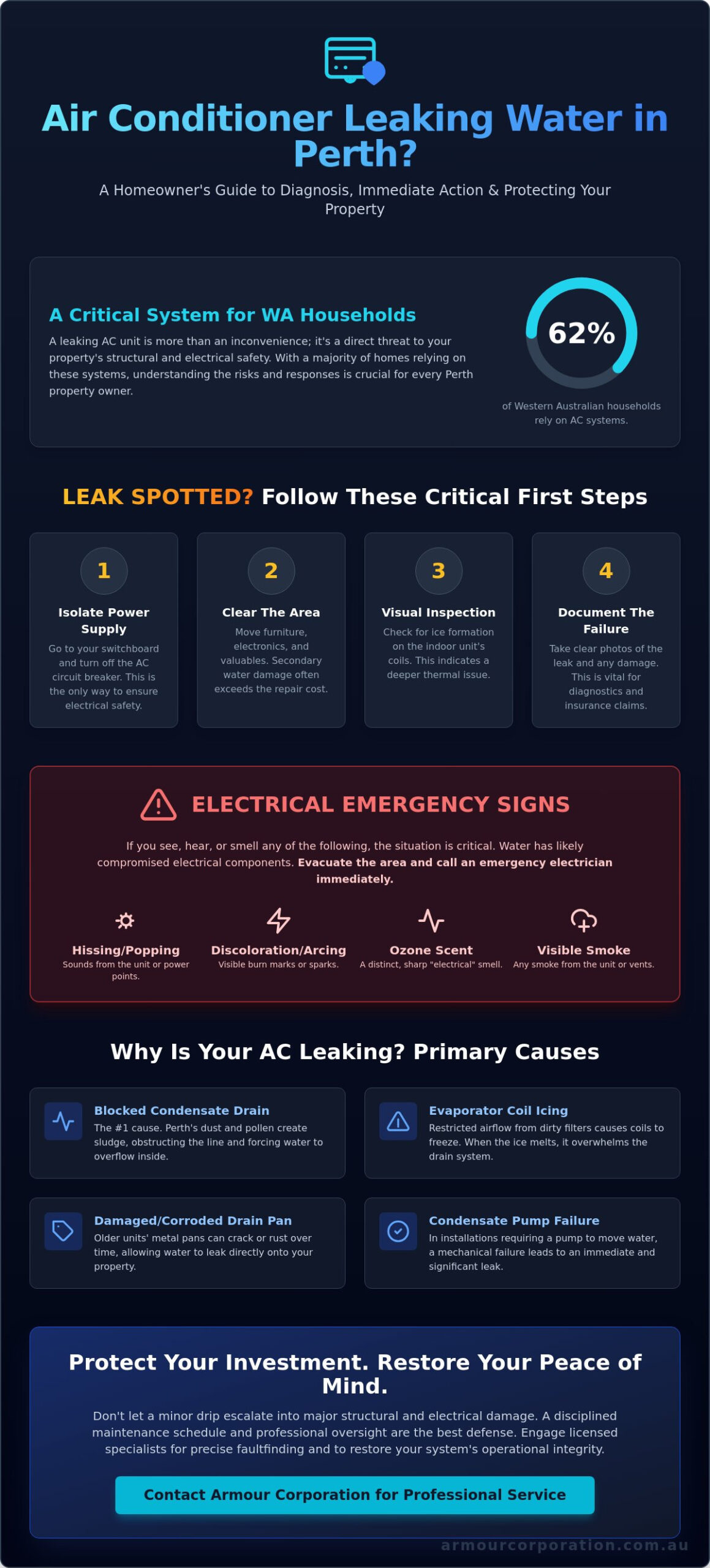
A consistent drip from your cooling system is more than a minor inconvenience; it’s a direct threat to your property’s structural integrity and electrical safety. You’ve likely invested significantly in your home, and the sight of moisture pooling near expensive flooring or decorative ceilings is understandably alarming. Addressing an air conditioner leaking water Perth residents often encounter requires a disciplined diagnostic approach to prevent irreversible damage. With 62% of Western Australian households relying on these systems for essential climate control, maintaining operational stability is a priority for every property owner.
Armour Corporation provides the professional oversight necessary to identify the specific failure points causing moisture ingress and determine if your unit remains safe for operation. This guide will help you understand the root causes of system failure and implement high-tier mitigation strategies to protect your investment. You’ll gain the clarity needed to stop the leak immediately and secure a reliable technical solution that restores your system’s performance and your peace of mind.
Key Takeaways
- Learn the critical first steps to take when you identify an air conditioner leaking water Perth, including isolating the power supply at the switchboard to mitigate electrical risks.
- Understand the primary mechanical failures, such as blocked condensate drain lines and evaporator coil icing, that lead to indoor unit overflows.
- Discover how Perth’s unique climate and rapid-build installation shortcuts contribute to system instability and drainage failures.
- Implement a disciplined maintenance schedule and technical cleaning protocols to ensure your system operates at peak efficiency while protecting your property.
- Identify the necessity of engaging licensed specialists for precise faultfinding and the restoration of your system’s operational integrity.
Immediate Response: What to Do When Your AC Leaks Water
When you observe an air conditioner leaking water Perth property owners must act with immediate precision. The presence of moisture within an electrical appliance is a high-stakes scenario that requires a disciplined response. Armour Corporation advises a structured protocol to mitigate both structural damage and electrical hazards. Swift intervention prevents a minor drip from escalating into a comprehensive system failure or a costly restoration project.
- Isolate the power supply at the switchboard. Don’t rely solely on the remote control or wall switch. Complete isolation at the circuit breaker is the only way to ensure the system is electrically inert and safe for inspection.
- Clear the area beneath the unit. Move furniture, electronics, and textiles immediately. Secondary damage to expensive flooring or property often exceeds the cost of the mechanical repair itself.
- Conduct a visual inspection. Open the front panel of the internal unit to observe the evaporator coils. Look specifically for ice formation, which indicates a thermal imbalance within the HVAC systems and requires professional attention.
- Document the failure. Take clear photographs of the leak’s origin and any affected surfaces. This data is essential for professional diagnostics and potential insurance claims.
The Critical Link Between Water and Your Electrical System
Internal condensation doesn’t always follow a predictable path. In many cases, moisture can track along internal wiring into electrical terminals. This creates a high risk of short-circuiting. Your property’s RCDs (Residual Current Devices) are designed to detect these imbalances and trip the power, but they aren’t a substitute for manual isolation. Attempting to “power through” a leak often results in a total system short-circuit, leading to far more expensive electrical installation repairs than a simple drain clearance.
When to Treat a Leak as an Electrical Emergency
Certain indicators suggest the leak has already compromised the electrical integrity of the unit. If you hear “hissing” or “popping” sounds, or notice discolouration on the unit’s casing or nearby power points, the situation is critical. These are signs of active electrical arcing. Should you detect the scent of ozone or visible smoke, evacuate the immediate area and contact an emergency electrician immediately. Armour Corporation maintains a posture of readiness for these high-risk faults, ensuring your Perth property remains secure during a system failure.
Primary Causes of Air Conditioning Leaks in Perth Homes
Identifying the catalyst for an air conditioner leaking water Perth residents observe is a matter of technical precision. Most failures originate from a disruption in the moisture management cycle. When the system’s ability to channel liquid away is compromised, the result is an immediate breach of the unit’s internal containment. Armour Corporation prioritizes a thorough diagnostic approach to determine whether the issue is a simple obstruction or a deeper mechanical failure.
- Blocked Condensate Drain Lines: This is the primary cause of indoor unit overflows. Perth’s unique environmental factors, including high levels of dust and seasonal pollen, accelerate the accumulation of biological sludge within the line. This obstruction forces water back into the internal unit, resulting in a predictable overflow.
- Evaporator Coil Icing: Restricted airflow creates a dangerous feedback loop. When filters are neglected, the refrigerant temperature drops below freezing, causing the coils to ice over. When this ice eventually melts, the volume of water often exceeds the drainage system’s capacity.
- Damaged or Corroded Drain Pans: Older residential units in Perth frequently feature metal drain pans. Over time, constant exposure to moisture leads to corrosion and structural fractures, allowing water to bypass the drain line entirely.
- Condensate Pump Failure: In multi-storey homes or apartment installations, systems often rely on a pump to move water against gravity. A mechanical failure in this pump leads to an immediate and significant leak.
Mechanical Failures vs. Maintenance Neglect
A clear distinction exists between component failure and maintenance neglect. While a cracked pan is a mechanical issue, a blocked line is often the result of deferred care. Low refrigerant levels also play a critical role; they destabilize the thermal balance and cause the coils to freeze. Following standard AC maintenance tips can mitigate many of these risks before they necessitate professional intervention. If your system shows signs of persistent moisture, professional faultfinding and repair of electrical installations ensures the root cause is addressed without risking damage to the unit’s internal circuitry.
The Physics of Condensation in High-Humidity Cycles
Condensation is a natural byproduct of the cooling process. As warm air passes over the cold evaporator coils, it loses moisture. Condensate is the byproduct of heat exchange between air and refrigerant. During extreme Perth heatwaves, systems operate at maximum capacity. This generates higher volumes of water that test the limits of the drainage infrastructure. When humidity spikes unexpectedly, even a partially clear drain line may fail to keep pace with the increased output, leading to a visible leak.
The Perth Factor: Why Local Climate and Building Standards Matter
Perth’s meteorological profile presents a unique challenge for residential and commercial cooling infrastructure. While our region is characterized by arid conditions, the sudden humid bursts common in late summer place immense pressure on drainage systems. An air conditioner leaking water Perth residents encounter is often a direct result of these atmospheric shifts. When humidity levels spike, the volume of condensate produced can double within hours. If the system’s drainage capacity was designed solely for dry conditions, it will inevitably reach a failure point. Armour Corporation ensures that every system we oversee is configured to handle these peak environmental loads.
In high-growth corridors such as Alkimos and Baldivis, the speed of residential construction has occasionally compromised installation quality. We frequently observe shortcuts in these rapid-build suburbs that lead to long-term operational instability. A critical factor is the “Perth Tilt.” Precision leveling is required to ensure that gravity-fed drainage operates without interruption. Even a minor deviation in the unit’s horizontal alignment can cause water to pool in the internal tray rather than exiting through the designated line. This oversight eventually leads to an internal breach and property damage.
Adherence to Western Australian building and electrical codes is a mandatory requirement for system longevity. The Home Building Contracts Act 1991 and local energy standards dictate specific material and installation protocols. Armour Corporation maintains a posture of strict compliance with these regulations to ensure that every installation meets the highest engineering standards. This disciplined approach to oversight prevents the structural compromises that often lead to moisture ingress.
Common Installation Errors in WA Residential Developments
Technical failures often begin within the wall cavity. Incorrect pipe insulation is a frequent offender, leading to “sweating” where moisture forms on the exterior of the pipes and drips directly into the building’s structure. Undersized drain lines are also common in budget-focused developments; these lines lack the diameter necessary to evacuate water during peak heatwaves. We also find that construction debris, such as brick dust or insulation fragments, often enters the drainage points during the final stages of a build. This creates an immediate obstruction that results in an air conditioner leaking water Perth owners must address early in the unit’s lifecycle.
Environmental Challenges for Perth AC Units
The geographic location of your property dictates its maintenance requirements. In coastal suburbs like Cottesloe, salt-laden air accelerates the corrosion of metal components, particularly the drain pan and external condenser coils. Conversely, properties further inland face the persistent threat of red dust. This fine particulate matter acts as a binding agent when mixed with condensate, forming a thick sludge that clogs internal filters and drain lines with remarkable speed. For residents in these corridors, a more aggressive maintenance posture is required to preserve system integrity and prevent moisture-related faults.
Professional Maintenance: Preventing Future Operational Failures
Reactive repairs are an insufficient strategy for maintaining high-value cooling infrastructure. Once you have addressed an air conditioner leaking water Perth property owners must shift their focus toward a posture of preventative oversight. Armour Corporation advocates for a disciplined air conditioner service schedule to ensure that system components remain within their intended operational parameters. With 62% of Western Australian households relying on these systems, professional maintenance is the only verified method for preventing the recurrence of moisture-related faults.
Technical cleaning of the evaporator coil is a cornerstone of our maintenance protocol. Over time, microscopic debris accumulates on the coil surfaces, insulating them and hindering efficient heat exchange. This leads to the evaporator coil icing discussed previously. By restoring the coil’s thermal conductivity, we eliminate the primary catalyst for freezing and subsequent melting. Precision is mandatory. We also verify the refrigerant charge during every visit, as even a minor depletion can destabilize the entire cooling cycle and trigger an overflow.
Electrical integrity is inseparable from mechanical performance. Armour Corporation integrates RCD and smoke alarm testing into our comprehensive maintenance visits. We inspect all internal wiring for signs of moisture ingress or thermal stress. Ensuring that electrical connections are tight and that the circuit integrity is uncompromised prevents the risk of short-circuits that water leaks often introduce. This holistic approach secures both the appliance and the property’s electrical network.
The Armour Maintenance Protocol
A professional service extends far beyond a simple filter rinse. Our technicians conduct a rigorous inspection of the condensate pump and drain pan to identify early signs of structural fatigue or mechanical wear. We perform a high-pressure flush-test of the entire drain line, utilizing specialized anti-fungal treatments. This process eradicates the biological sludge that is the leading cause of obstructions in Perth’s climate. We also verify that all electrical terminals remain isolated from potential moisture paths, maintaining a barrier against high-stakes operational failure.
Long-term Protection Against Mould and Structural Damage
Persistent moisture ingress often results in hidden mould growth within Perth’s gyprock walls and ceiling cavities. This biological contamination can remain undetected for months, compromising indoor air quality and structural stability. The cost-benefit analysis of preventative maintenance is clear; a scheduled service is a fraction of the cost of emergency ceiling restoration or mould remediation. Industry data indicates that professional maintenance extends system lifespan by up to 40% while ensuring the unit operates at peak energy efficiency. To secure your property against future leaks, contact Armour Corporation for a comprehensive electrical and air conditioning diagnostic.
Restoring System Integrity with Armour Corporation
Armour Corporation stands as the definitive barrier against the operational risks associated with an air conditioner leaking water Perth properties often endure. Resolving a moisture breach is not merely a matter of clearing a pipe; it requires a meticulous evaluation of the system’s total integrity. We provide a comprehensive diagnostic service that addresses the mechanical, structural, and electrical failure points of your cooling infrastructure. This disciplined approach ensures that once a leak is mitigated, the system is returned to a state of absolute stability and safety.
Complex leak resolution necessitates the oversight of a licensed specialist. Because internal condensation can compromise electrical terminals, our technicians utilize advanced faultfinding and repair of electrical installations to identify hidden short-circuits or insulation failures. We maintain a posture of strict compliance with Western Australian engineering standards, ensuring every repair meets the rigorous requirements of the Building Codes of Australia. This commitment to precision protects your investment and ensures your property remains within regulatory compliance.
Armour Corporation provides a rapid response for residential, commercial, and industrial clients across the Perth metropolitan area. We recognize that system downtime in our local climate is more than an inconvenience; it’s a risk to productivity and comfort. Our team arrives prepared with the latest diagnostic technology to conduct a thorough observation of your system’s performance, leaving no detail overlooked in the pursuit of operational mastery.
The Elite Choice for Perth Climate Control
Armour Corporation is a family-owned Western Australian business with a heritage defined by accountability and high-stakes oversight. We do not utilize substandard components or temporary fixes. Instead, we employ premium products and sophisticated diagnostic tools to ensure a permanent resolution to your system’s failure. Our personality is that of a disciplined guardian; we take pride in our ability to provide psychological reassurance through technical mastery. This creates a brand experience that is both formidable to technical challenges and deeply supportive of our clients’ needs.
Securing Your Property with Professional Oversight
Our objective is to translate complex operational logistics into clear, value-driven outcomes for your property. By engaging Armour Corporation, you’re not just hiring a technician; you’re securing the long-term health of your home or business infrastructure. We provide a final assurance of system safety, verifying that every component is optimized for energy efficiency and moisture management. This strategic oversight prevents future failures and maintains the impenetrable barrier between your property and the elements. Secure your home’s comfort and safety today. Contact Armour Corporation for AC repair in Perth and restore your system’s operational integrity.
Securing Your Property Against Moisture and Electrical Failure
Managing a cooling system failure requires more than a temporary fix; it demands a disciplined diagnostic approach that addresses the root cause of moisture ingress. You’ve learned that immediate power isolation and an understanding of the unique environmental factors in Western Australia are essential for protecting your property’s structural and electrical integrity. Armour Corporation provides the professional oversight necessary to ensure every air conditioner leaking water Perth residents encounter is resolved with engineering precision.
Our team consists of qualified Master Electricians who are specialists in both split and ducted systems. As a WA family-owned and operated business, we maintain an unwavering commitment to operational mastery and psychological reassurance. We translate complex technical failures into clear, value-driven solutions that restore your system’s peak performance. Vigilance today prevents the structural and electrical compromises of tomorrow.
Restore Your AC Efficiency with Armour Corporation. Implementing a professional maintenance schedule now ensures a secure and efficient climate control environment for the seasons ahead.
Frequently Asked Questions
Is it safe to run my air conditioner if it is leaking water inside?
Running a system while it is actively discharging moisture internally is unsafe. Water can infiltrate sensitive electrical components and cause permanent damage to the control board or internal wiring. It is critical to isolate the unit at the circuit breaker to prevent secondary electrical faults. Armour Corporation advises a full diagnostic inspection before restoring power to ensure the system’s operational integrity is not compromised.
Can a leaking air conditioner cause an electrical fire?
Moisture ingress into electrical systems presents a legitimate fire risk. When water tracks into terminals or power points, it can cause electrical arcing and intense heat within the unit or wall cavity. This is why properly functioning RCDs are an essential safety barrier. If you notice an air conditioner leaking water Perth residents should treat the situation with vigilance to avoid high-stakes electrical hazards.
Why does my air conditioner leak water only when it is very hot in Perth?
Extreme heatwaves in Perth force the system to work at maximum capacity, generating a significantly higher volume of condensate. A drain line that is partially obstructed might handle a minor drip but will overflow when the condensation rate peaks. This environmental pressure exposes maintenance gaps that are not apparent during milder weather. It indicates that the system’s drainage infrastructure requires professional clearance to handle peak loads.
How much does it typically cost to fix an AC leak in Western Australia?
Repair costs vary based on the complexity of the fault and the required replacement components. While industry rates for domestic and commercial repairs are established in Western Australia, the specific investment depends on whether the issue is a simple blockage or a mechanical failure like a cracked pan. Property owners should consult a licensed specialist for a precise quote after a thorough on-site diagnostic has been performed.
Will a dirty air filter really cause my AC to drip water?
A restricted air filter is a frequent catalyst for internal dripping. When airflow is impeded, the temperature of the evaporator coil drops below freezing, causing ice to accumulate on the unit. When the unit cycles off or the ice becomes too heavy, it melts rapidly and overwhelms the condensate tray. Maintaining clean filters is a fundamental requirement for preventing this specific thermal imbalance and subsequent leak.
What happens if water from my AC gets into the light fittings or power points?
Water entering electrical fittings is a critical safety event that requires immediate intervention. This scenario can lead to short circuits, equipment failure, or fire within the ceiling space or wall cavities. You must isolate the power at the switchboard immediately and refrain from using those circuits until a qualified electrician has verified they are dry and safe. Armour Corporation prioritizes these high-risk faults to secure your property.
How often should I have my split system serviced to prevent leaks?
Standard engineering protocols suggest an annual professional service for most residential systems. However, properties in high-dust corridors or coastal areas of Perth may require bi-annual maintenance to manage salt corrosion and particulate buildup. Regular oversight ensures that the drainage system remains clear and that the electrical connections are secure, preventing the conditions that lead to indoor unit overflows and structural damage.
Does a leaking air conditioner mean I need to regas the unit?
A leak does not automatically indicate a need for refrigerant replacement, though the two issues are sometimes linked. Low gas levels cause the coils to freeze, which leads to water discharge as the ice melts. However, most leaks are caused by simple drainage obstructions or mechanical pan failures. A professional diagnostic is the only way to determine if a refrigerant recharge is technically necessary for your system.
